Murray law-based quantitative flow ratio for optimizing revascularization in anterior ST-elevation myocardial infarction due to spontaneous coronary artery dissection: a case report
European Heart Journal - Case Reports


Abstract
Spontaneous coronary artery dissection (SCAD) is a rare, non-atherosclerotic cause of acute coronary syndrome (ACS) characterized by compression of the coronary true lumen by a blood-filled false lumen. Conservative management is recommended for most cases, with percutaneous coronary intervention (PCI) reserved for patients with significant ischaemia, reduced coronary blood flow, or haemodynamic instability. Percutaneous coronary intervention in SCAD is challenging, with a high complication rate, and the optimal approach remains debated.
We describe a 43-year-old woman presenting with acute retrosternal chest pain and ST-segment elevation consistent with an anterior ST-elevation myocardial infarction. The patient medical history included hypertension, smoking, recent hormonal therapy, and prednisone use. Emergent coronary angiography revealed a type IIb SCAD in the mid-left anterior descending artery with vessel occlusion. Plain balloon angioplasty successfully restored good antegrade flow (TIMI 3), deferring the decision of stent implantation on follow-up coronary angiography. Murray law-based quantitative flow ratio (μQFR) revealed a haemodynamically non-significant lesion at 10 days of follow-up. The patient remained stable, demonstrating recovery of myocardial function and no recurrent symptoms at 12-months of follow-up.
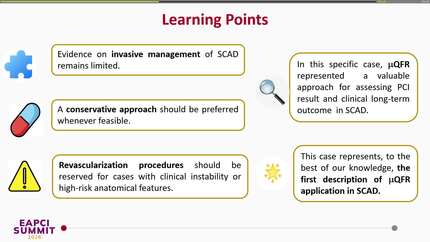
Murray law-based quantitative flow ratio offers a non-invasive tool to guide revascularization in SCAD patients. While promising, evidence for μQFR in SCAD is lacking, highlighting the need for further studies to validate its utility in this context.
Contributors





You may be interested in