Effect of trimetazidine dihydrochloride therapy on myocardial external efficiency in pre-clinical individuals with a hypertrophic cardiomyopathy pathogenic variant: results of the ENERGY trial

Cardiovascular Research

2 July 2025
Organised by: Logo
ESC Journals CARDIOVASCULAR PHARMACOLOGY IMAGING Cardiac Magnetic Resonance (CMR) Cross-Modality and Multi-Modality Imaging Topics Nuclear Imaging VALVULAR, MYOCARDIAL, PERICARDIAL, PULMONARY, CONGENITAL HEART DISEASE Myocardial Disease

Abstract

AbstractAims

Previous studies have shown that individuals with a hypertrophic cardiomyopathy (HCM) pathogenic variant (PV) or likely pathogenic variant (LPV) without a HCM phenotype (PV/LPV carrier) have decreased myocardial external efficiency (MEE), which is thought to be a key pathomechanism in the onset and progression of HCM. Metabolic treatments improved exercise capacity in HCM patients, but evidence that such drugs correct reduced MEE is lacking. The ENERGY trial is a double-blind, placebo-controlled randomized clinical trial to define if the metabolic drug trimetazidine (TMZ) corrects reduced MEE in PV/LPV carriers for HCM.

Methods and results

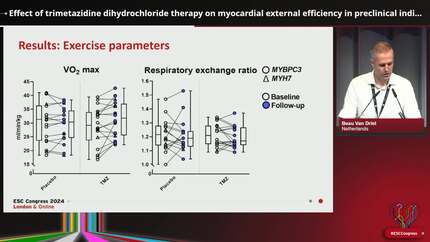
51 MYBPC3 or MYH7 PV/LPV carriers were screened after which 40 were included and randomized into a treatment group (n = 20) or placebo group (n = 20) stratified for sex. Participants were treated with TMZ 20 mg or placebo three times daily during 8 weeks. The main outcome of this study was MEE as measured by [11C]-acetate positron emission tomography/computed tomography (PET/CT) and cardiac magnetic resonance (CMR) scan. Secondary outcomes were exercise parameters as measured by cardio-pulmonary exercise testing (CPET). Drug safety was monitored by (serious) adverse event registration. Treatment groups were comparable in terms of age, sex, body mass index, P/LP gene variant, and echocardiographic parameters without significant differences. Baseline CMR parameters and MEE were not significantly different between treatment groups. Eight weeks of treatment with TMZ did not significantly alter MEE compared to placebo. The mean MEE changed from 30.3 ± 3.8 to 29.8 ± 4.3% in the placebo group and from 30.1 ± 4 to 29.1 ± 4% in the TMZ group. Compared to placebo, the TMZ group did not have a significantly different MEE (difference −0.44, 95% interaction CI, −2.863 to 1.986, P = 0.68). The mean V′O2max as a percentage of predicted V′O2max (V′O2max %pred) changed from 108 ± 17 to 111 ± 19 (95% CI, −6 to 10, P = 0.84) percent in the placebo group and from 105 ± 17 to 113 ± 14 (95% CI, 1 to 16, P = 0.03) percent in the TMZ group. After adjustment for baseline, the TMZ group had a significantly increased V′O2max %pred (difference 6.37, 95% interaction CI, −3 to 16, P = 0.04).

Conclusion

The ENERGY trial is the first proof-of-concept randomized controlled trial to test the hypothesis that TMZ improves MEE in MYBPC3 or MYH7 PV/LPV carriers. We conclude that metabolic therapy with TMZ may not correct the P/LP gene variant-related decrease in MEE.

Trial registration

Netherlands Trial Register NL7492 (URL https://onderzoekmetmensen.nl/nl/trial/25078)

Contributors

Stephan A C Schoonvelde

Author

Erasmus University Medical Centre Rotterdam , Netherlands (The)

Sonia Borodzicz-Jazdzyk

Author

Medical University of Warsaw Warsaw , Poland

Lourens Robbers
Lourens Robbers

Author

Amsterdam University Medical Centre (AUMC) Amsterdam , Netherlands (The)

Judith Verhagen
Judith Verhagen

Author

Erasmus University Medical Centre Rotterdam , Netherlands (The)

Jolanda van der Velden

Author

Amsterdam University Medical Centre (AUMC) Amsterdam , Netherlands (The)