Coronary revascularization and sex differences in cardiovascular mortality after myocardial infarction in 12 high and middle-income European countries
European Heart Journal - Quality of Care and Clinical Outcomes


Abstract
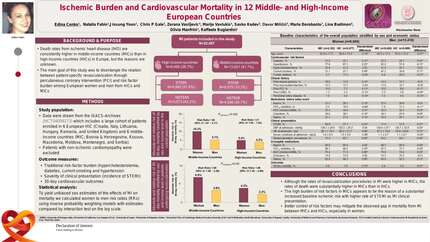
Existing data on female sex and excess cardiovascular mortality after myocardial infarction (MI) mostly come from high-income countries (HICs). This study aimed to investigate how sex disparities in treatments and outcomes vary across countries with different income levels.
Data from the ISACS Archives registry included 22 087 MI patients from 6 HICs and 6 middle-income countries (MICs). MI data were disaggregated by clinical presentation: ST-segment elevation myocardial infarction (STEMI) and non-ST-segment elevation myocardial infarction (NSTEMI). The primary outcome was 30-day mortality.
Among STEMI patients, women in MICs had nearly double the 30-day mortality rate of men [12.4% vs. 5.8%; adjusted risk ratio (RR) 2.30, 95% CI 1.98–2.68]. This difference was less pronounced in HICs (6.8% vs. 5.1%; RR 1.36, 95% CI 1.05–1.75). Despite more frequent treatments and timely revascularization in MICs, sex-based mortality differences persisted even after revascularization (8.0% vs. 4.1%; RR 2.05, 95% CI, 1.68–2.50 in MICs and 5.6% vs. 2.6%; RR 2.17, 95% CI, 1.48–3.18) in HICs. Additionally, women from MICs had higher diabetes rates compared to HICs (31.8% vs. 25.1%, standardized difference = 0.15). NSTEMI outcomes were relatively similar between sexes and income groups.
Sex disparities in mortality rates following STEMI are more pronounced in MICs compared to HICs. These disparities cannot be solely attributed to sex-related inequities in revascularization. Variations in mortality may also be influenced by sex differences in socioeconomic factors and baseline comorbidities.
Contributors


Jinsung Yoon
Author

Chris P Gale
Author
Zorana Vasiljevic
Author

Sasko Kedev
Author
Davor Miličić
Author
Maria Dorobantu
Author
Lina Badimon
Author


You may be interested in