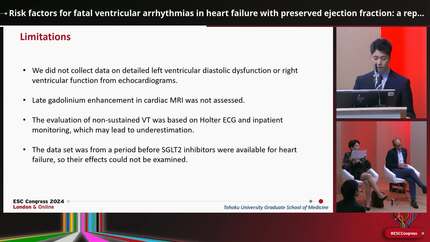
Association of a mild or an important decline in left ventricular ejection fraction with ventricular tachyarrhythmias, sudden cardiac death, and all-cause death in heart failure with preserved ejection fraction: a report from the CHART-2 Study
EP Europace Journal


Abstract
A decline in left ventricular ejection fraction (LVEF) is often observed in patients with heart failure with preserved ejection fraction (HFpEF) and is associated with adverse outcomes. Although baseline LVEF is crucial for assessing the risk of sudden cardiac death in patients with HF, little is known about the relationship between the decline in LVEF and lethal arrhythmic events among patients with HFpEF.
We retrospectively analysed data from the CHART-2 Study. A total of 1453 patients with HF and LVEF ≥ 50% at registration (73 years, 39% female) were included and categorized into three groups based on their LVEF at the prespecified 1-year follow-up; 1316 with LVEF ≥ 50%, 120 with LVEF 36–50%, and 17 with LVEF ≤ 35%. The primary endpoint was a composite of ventricular tachycardia, ventricular fibrillation, and sudden cardiac death. All-cause death was also evaluated. During a median follow-up of 7.9 years, 79 (5.4%) patients experienced a composite event. Patients with LVEF < 50% at 1 year had a significantly higher incidence of the composite event (11.7 vs. 4.8%,
In patients with HFpEF, even a mild decline in LVEF was associated with a higher risk of ventricular tachyarrhythmia, sudden cardiac death, and all-cause death. Continuous clinical assessment and re-evaluation of LVEF is crucial for the management of patients with HFpEF.
Contributors



Takashi Shiroto
Author
Nobuhiko Yamamoto
Author
Hiroyuki Sato
Author
Hideka Hayashi
Author
Takahiko Chiba
Author
Makoto Nakano
Author
Hiroyuki Takahama
Author
Jun Takahashi
Author
Satoshi Miyata
Author
Hiroaki Shimokawa
Author
Satoshi Yasuda
Author
You may be interested in