Real-world experience with the pentaspline pulsed field ablation system: one-year outcomes of the FARADISE registry
EP Europace Journal


Abstract
Clinical studies with protocol-mandated workflow and monitoring have analysed performance of pulsed field ablation (PFA) for treating atrial fibrillation (AF). The FARADISE registry captures global use of the pentaspline PFA catheter in real-world clinical practice with a follow-up of 3 years.
FARADISE is a prospective, non-randomized, multi-national registry (NCT05501873) that enrolled subjects clinically indicated for ablation using the pentaspline PFA catheter per medical judgement and hospital standard-of-care. Procedural characteristics, safety, and clinical effectiveness up to 12-months were collected. In total, 1158 AF patients received PFA across 48 centres in 21 countries (64 ± 11 years, 33% female, 90%
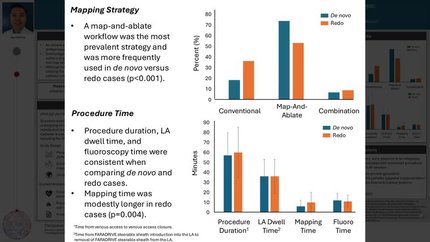
The FARADISE registry provides a snapshot of real-world clinical use of the pentaspline PFA catheter. Acute results demonstrate favourable procedural and safety outcomes regardless of AF indication. One-year outcomes are encouraging, with no differences seen within indication based on ablation strategy.
Contributors


Gábor Széplaki
Author
Antonio Dello Russo
Author
Ignacio García-Bolao
Author
Michael Efremidis
Author
Nándor Szegedi
Author
Stephan Willems
Author
Haris Haqqani
Author

Francesco Solimene
Author
George Andrikopoulos
Author
Martin Fiala
Author
Pascal Defaye
Author
Armin Luik
Author
Patrick Lugenbiel
Author
Lars Eckardt
Author
Alexandre Ouss
Author
Jean-Manuel Herzet
Author
Javier Ramos Maqueda
Author
Sélim Abbey
Author
Azlan Hussin
Author
Nele Cielen
Author
Madeline Johnson
Author
Elizabeth M Albrecht
Author
Brad S Sutton
Author
Johan Vijgen
Author
You may be interested in