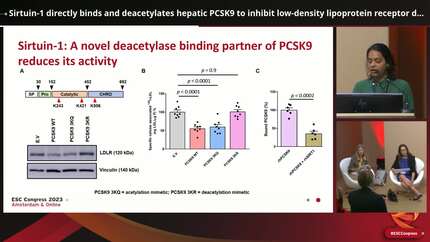
Sirtuin-1 directly binds and deacetylates hepatic PCSK9 thereby promoting the inhibition of LDL receptor degradation
Cardiovascular Research


Abstract
Low-density lipoprotein (LDL)-cholesterol is causally involved in atherosclerotic cardiovascular disease (ASCVD) pathogenesis. Pharmacological activation of the intracellular NAD + -dependent deacetylase Sirtuin-1 (SIRT1) reduces plasma LDL-cholesterol levels by increasing hepatic LDL-receptor (LDLR) expression, which intriguingly associates with atheroprotective effects. Recent studies have identified the presence of SIRT1 in plasma, however, its effects remain elusive. We found that plasma levels of SIRT1 to be decreased in atherosclerotic mice compared with wild-type controls and aimed to investigate the therapeutic potential of systemic SIRT1 restoration on lipid metabolism and plaque burden in atherosclerotic mice and dissect the underlying molecular mechanisms involved.
Twelve-week-old apolipoprotein E-deficient (
SIRT1 directly binds hepatic PCSK9 and decreases its activity by deacetylation, thereby enhancing LDL-cholesterol clearance by hepatic LDLR upregulation. Boosting circulating SIRT1 exerts atheroprotective effects in mice, with high levels associating with improved prognosis in patients with established ASCVD.
Contributors

Giovanni G Camici
Author

Thomas F Lüscher
Author
Royal Brompton and Harefield NHS Foundation Trust London , United Kingdom of Great Britain & Northern Ireland

Melroy X Miranda
Author
Priyanka Adla
Author

Shafeeq A Mohammed
Author
Shekhar Baki
Author
Jerome Robert
Author
Lucia Rohrer
Author
Hwan Lee
Author
Hyun-Duk Jang
Author
Slayman Obeid
Author
Anne Tailleux
Author
Bart Staels
Author
Naresh Babu V Sepuri
Author

Francesco Paneni
Author
Center for Translational and Experimental Cardiology (CTEC) Zurich , Switzerland
Ravi Kumar Gutti
Author
Arnold von Eckardstein
Author
Hyo-Soo Kim
Author

You may be interested in