Bridging the cardio-oncology gap with insights from a functional TTN-truncating variant model
European Heart Journal Supplements


Abstract
Truncating variants in TTN (TTNtv) are present in around 7% of patients with anthracycline-induced cancer therapy-related cardiac dysfunction (CTRCD). In dilated cardiomyopathy, proximal I-band TTNtv (TTNtvI) harbour less pathogenic potential than distant A-band TTNtv (TTNtvA).
To assess if a location-dependent effect of TTNtv is at play in an anthracycline-induced CTRCD, in order to refine risk stratification in patients.
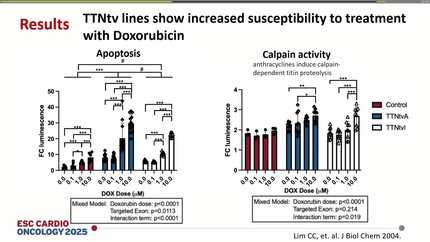
Distinct isogenic TTNtv hiPSC lines were created using CRISPR/Cas9 starting from an in-house reprogrammed hiPSC line of a healthy female control individual. Exon 48 (E48), located in the I-band, and exon 357 (E357), located in the A-band were targeted, based on variants identified in our CTRCD population. Differentiation of iPSCs to cardiomyocytes was performed using an in-house established protocol, each of the lines was differentiated at least two times. Expression of cardiac markers and TTN was evaluated with immunocytochemistry. For assessment of contractility, bright-field videos of contracting monolayers were obtained at day 27-44 and analysed using Musclemotion software. Next, doxorubicin (DOX) was added for 24 hours (0, 0.1, 1 or 10 µM) and contractility imaging was repeated. After DOX-treatment, apoptosis (as Caspase 3 activity) and calpain activity were assessed using luciferase assays (Caspase-Glo 3/7 Assay and Calpain-GloTM Protease Assay respectively).
We created two isogenic hiPSC lines with a heterozygous TTNtvI (E48): E48_C1: c.13836_13853del and E48_C2: c.13836_13838delTTTinsGATACATACAA, and two with a heterozygous TTNtvA (E357): E357_C1: c. 100373delT and E357_C2: c. 100372_100373insT.
In all cell lines, 24 hours treatment with DOX resulted in increased nuclear staining for distal titin. Overall, cells became less elongated and shorter segments of striated titin were observed at higher DOX doses, indicating an impact on cell architecture. Apoptosis significantly increased with increasing DOX dose and according to cell line, with lowest values in the isogenic control and highest values in TTNtvA. Similarly, Calpain activity increased with higher DOX dose, and this was most outspoken in TTNtvA, present in TTNtvI, but absent in the control cell line. The impact on contractility however was less clear, as no linear DOX dose related effects were observed. However, DOX-dose and targeted exons still showed a significant interaction (p<0.0001) indicating a different sensibility to DOX according to which exon was targeted. For each DOX dose, TTNtvA and TTNtvI hiPSC-CMs had significantly lower contractility than the control cell line.
DOX influenced cell architecture and nuclear presence of distal titin in all cell lines. Heterozygous TTNtvI and TTNtvA hiPSC-CMs show increased apoptosis and calpain activity in response to DOX treatment, suggesting an increased predilection for cardiotoxicity. Effects were more prominent in TTNtvA than in TTNtvI hiPSC-CMs.
Contributors



You may be interested in