Expert opinion on the integration of combination therapy into the treatment algorithm for the management of dyslipidaemia: the integration of ezetimibe and bempedoic acid may enhance goal attainment
European Heart Journal - Cardiovascular Pharmacotherapy


Abstract
The clinically important link between LDL cholesterol (LDL - C) lowering and cardiovascular (CV) risk reduction is well-established and reflected in the 2019 European Society of Cardiology/European Atherosclerosis Society guidelines for the management of dyslipidaemia. They recommend a stepwise approach to reaching LDL - C goals, beginning with statin monotherapy at the highest tolerated dose. However, real-world data show a large gap between guideline LDL - C goal recommendations and their achievement in clinical practice. The treatment paradigm should shift from the concept of high-intensity statins to that of high-intensity, lipid-lowering therapy (LLT), preferably as upfront combination LLT, to overcome the residual CV risk associated with inadequate lipid management.
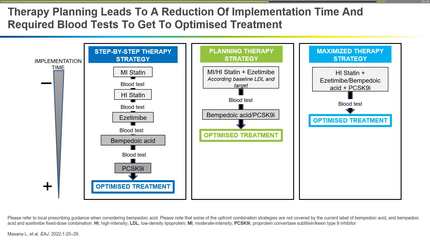
A multidisciplinary expert panel convened to propose treatment algorithms to support this treatment approach in patients at high and very high CV risk. The experts completed a questionnaire on the benefits of combination therapy and the role that novel LLTs, including bempedoic acid, might play in future guidelines. The integration of new LLTs into the suggested treatment algorithms for patients at high CV risk, very high CV risk, and those with complete or partial statin intolerance was discussed. Each algorithm considers baseline CV risk and LDL - C levels when recommending the initial treatment strategy. This expert consensus endorses the use of statin combination therapy as first-line therapy in patients at high and very high CV risk, and, in some circumstances, in patients with statin intolerance when appropriate. Given recent, compelling evidence, including real-world data, combination therapy as first-line treatment should be considered to help patients achieve their LDL - C goals.
Contributors

Heinz Drexel
Author
Vorarlberg Institute for Vascular Investigation and Treatment Feldkirch , Austria

Ioanna Gouni-Berthold
Author
Leopoldo Pérez de Isla
Author
Ernst Rietzschel
Author

Kausik K Ray
Author


Maciej Banach
Author
You may be interested in