HSP27, an alarmin associated with ventricular fibrillation after STEMI
EP Europace Journal


Abstract
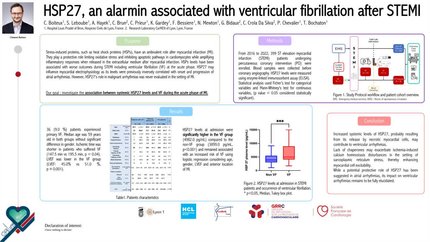
Ventricular fibrillation (VF) during acute myocardial infarction (MI) is a critical concern, affecting nearly 10% of MI patients, with survival rates remaining alarmingly low. MI induces an inflammatory response whose magnitude has been associated with worse outcomes and an increased risk of malignant arrhythmias. Stress-induced proteins, such as heat shock proteins (HSPs), play a protective role within cardiomyocytes by acting as chaperones limiting oxidative stress and inhibiting apoptotic pathways. However, evidence suggests that once released into the extracellular environment, HSPs amplify inflammatory responses following MI, as increased levels in the acute phase were associated with major adverse cardiac events (MACE). The specific role of HSP27 in promoting arrhythmogenesis following myocardial infarction remains to be elucidated.
Our study aimed at investigating the association between systemic HSP27 levels and VF occurrence during the acute phase of MI before revascularization.
From 2016 to 2022, 399 ST elevation myocardial infarction (STEMI) patients undergoing percutaneous coronary intervention (PCI) were enrolled. Blood samples were collected before coronary angiography, and HSP27 levels were measured using enzyme-linked immunosorbent assay (ELISA). Left ventricular ejection fraction (LVEF) was assessed using transthoracic echocardiography. Statistical analysis used Ficher’s test for categorical variables and Mann-Whitney's test for continuous variables, while a p value < 0.05 was considered statistically significant.
Among 399 patients, 36 (9.0 %) experienced primary VF. Median age was 58 years old in both groups without significant difference in gender (80% male in the VF group vs 79% in the non-VF group). Ischemic time was shorter in patients who suffered VF (147.5 min IQR [120.0-228.0] vs 195.5 min IQR [130.8-352.5], p = 0.04). LVEF was lower in the VF group (LVEF: 45.0% IQR [35.0-55.0] vs 51.0 % IQR [45.0-60.0], p = 0.001). HSP27 levels at admission were significantly higher in the VF group (4982.0 pg/mL [IQR: 4056.0-8952.0]) compared to the non-PVF group (3899.0 pg/mL IQR [3013.0-5473.0], p<0.001). Higher HSP27 levels remained associated with an increased risk of VF using logistic regression considering age, gender, LVEF and anterior localization of MI (adjusted odds-ratio 3,39 95% confidence interval [1,5-7,8], p < 0.01).
Our findings reveal higher systemic levels of HSP27 in patients experiencing VF during MI. Since our study design cannot confirm causation, prospective studies are needed to clarify HSP27’s role in post-MI arrhythmogenesis. Nevertheless, our results suggest that HSP27 may contribute to cardiac electrical instability, highlighting its potential as a therapeutic target. HSP27 levels at admission after STEMI
Contributors

C Boiteux
Author
S Leboube
Author
A Hayek
Author
C Brun
Author
C Prieur
Author
K Gardey
Author
F Bessiere
Author
N Mewton
Author
G Bidaux
Author
C Crola Da Silva
Author
P Chevalier
Author
T Bochaton
Author
You may be interested in