New insights from repeated extra-cardiac vagal nerve stimulation after recent successful cardioneuroablation in high risk patients with vagally-mediated bradyarrhythmias
EP Europace Journal


Abstract
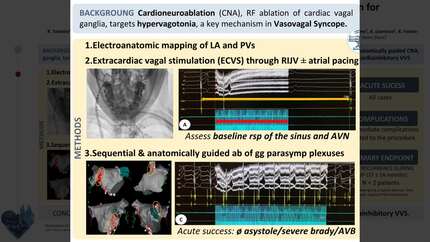
Extra cardiac vagal nerve stimulation are used before and immediately after cardioneuroablation as peri-procedural end-point of the procedure. Due to occupational medicine requirement and driving regulatory issues we have implemented non-invasive and invasive approach to validate short and long-term efficacy and safety of baseline ECVS-guided CNA in high risk patients with vagally mediated bradyarrhtyhmias. We aimed to characterize the incidence of symptomatic and asymptomatic functional bradycardia within a short- and long-term efficacy and safety in high-risk patients after initially successful ECVS-guided anatomic approach for binodal, biatrial CNA.
High-risk patients undergoing elective control by complex cardiovascular autonomic test and elective short-term invasive tests following the initially successful ECVS-guided binodal, biatrial CNA and further 12-month follow-up were investigated. The combined end-point for ECVS-guided CNA and persistence of parasympathetic denervation at baseline and during control procedure consisted of: 1) disappearance of sinus arrest 2) disappearance of prolonged severe sinus bradycardia < 40 bpm and/or 3) disappearance of advanced atrioventricular block.
Data were derived from the first consecutive 300 adult patients from multicenter POL-CA registry. Among the studied group 15% (45/300) patients were classified as high-risk syncope patients An elective second control EPS and ECVS were performed within 3.1 ± 2.0 months after initially successful ECVS-guided CNA procedure. In only 2/45 (5%) patients functional bradycardia episodes were symptomatic. During control study ECVS-induced severe bradycardic response for SAN and AVN were documented in 15/45 (33%) and 10/45 (22%) patients, respectively. In all patients with ECVS-induced severe single node or binodal bradycardia (18/45, 40% ) successful redo ECVS-guided CNA were performed. Within 1 month after control procedure all patients with negative repeat ECVS-guided management (with or without redo CNA) were accepted for high-risk professional activity, driving and permanent discontinuation of pacemaker therapy and TLE. In all 45/45 (100%) patients 12-month follow-up was asymptomatic.
In short-term follow-up, complete denervation assessed by ECVS persisted in only 60% (27/45) of patients after initially successful ECVS-guided CNA. However, clinical efficacy was proven in short-term follow-up in 95% (43/45) patients. Repeat ECVS may overestimate the need for redo CNA after initially successful, biatrial, binodal CNA, however enable the guidance of the management and very safe outcome within 12-month follow-up. For high risk syncope patients reassurance of efficacy of ECVS-guided CNA/redo CNA within short-term follow-up is crucial for occupational medicine requirements and assessment of patient eligibility for return to high-risk professional activity, driving and discontinuation of permanent pacemaker therapy.
Contributors

A Wileczek
Author
S Stec
Author
M Kornaszewska
Author
J Sledz
Author
L Konarski
Author
A Kustron
Author
P Skoczynski
Author
A Ratajska
Author
M Zajac
Author
You may be interested in