Abstract
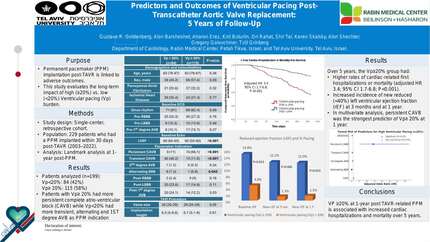
Permanent pacemaker (PPM) implantation following transcatheter aortic valve implantation (TAVI) is associated with a worse prognosis. This study aimed to assess negative outcomes post-PPM in the setting of TAVI in patients with and without high ventricular pacing (Vp) burden.
A single-center, retrospective cohort study of consecutive patients who underwent PPM implantation within 30 days post-TAVI from 2003 to 2022. Clinical outcomes were evaluated at 1, 3, and 5 years.
Among 1573 patients who underwent TAVI during the study period, 229 required a PPM, of whom 211 had complete Vp data and were included in the analysis: 84 (40%) patients with Vp<20% and 127 (40%) patients with Vp≥ 20%. Compared to patients with Vp<20%, the most common indication for PPM among those with Vp≥ 20% was persistent complete atrioventricular block (CAVB) (62.1% vs. 11.3, respectively, P<0.001) while transient CAVB was more prevalent in the latter group (49.4% vs. 15.6%, P<0.001). The incidence of the composite outcome of cardiac-related first readmission or mortality was significantly higher among patients with Vp≥ 20% throughout all time points (18.9% vs. 7.1%, P = 0.017; 30.7% vs. 16.7%, P=0.02; 43.3% vs. 19%, P<0.001; for 1, 3 and 5 years, respectively), driven primarily by higher mortality while the 5-year cardiac readmission rate was also significantly increased. Furthermore, the prevalence of reduced 3-month left ventricular ejection fraction (LVEF<40%) was higher in those with Vp≥ 20%, with 9.4% vs. 0% (in Vp<20%, P=0.005) developing new reduced LVEF. In multivariate analysis, CAVB was a significant predictors of Vp≥ 20% (ORCAVB=11.6, 95% CI 4.1-32.6, P<0.001) with a combined model AUC of 0.798 (95% CI 0.74-0.86, P<0.001) by ROC analysis.
VP ≥20% over 5 years of follow-up post-TAVI PPM implantation was associated with higher cardiac readmissions and mortality.
Contributors

G Goldenberg
Author
A Barsheshet
Author
A Erez
Author
K Buturlin
Author
G Golovchiner
Author
T Grinberg
Author
You may be interested in