Conduction system versus biventricular pacing upgrade in patients with pacing-induced cardiomyopathy
EP Europace Journal


Abstract
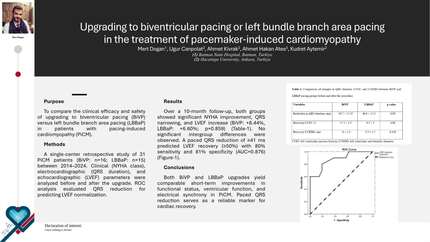
The feasibility and outcome of conduction system pacing (CSP) upgrade as an alternative modality to the traditional biventricular pacing (BVP) upgrade in patients with pacing-induced cardiomyopathy (PICM) remain uncertain.
We conducted an observational study aimed to compare CSP upgrade (His bundle pacing, HBP, or left bundle branch area pacing, LBBAP) with BVP upgrade in patients with PICM.
Consecutive patients with PICM who underwent CSP or BVP upgrade from 2018 to 2023 were included in the analysis. Echocardiographic response and the risk of a composite end-point including all-cause death or heart failure (HF) hospitalization were assessed during follow-up.
Eighty-six consecutive patients (79.7±7.0 years, 64.9% male, mean left ventricular ejection fraction, LVEF, 33.1±8.1%, mean NYHA class 3.0±0.4, mean duration of paced QRS 189.8±21.1 ms) were enrolled in the study: 37 underwent CSP upgrade (8 HBP, 29 LBBAP), and 49 underwent BVP upgrade. Compared to BVP upgrade, CSP upgrade was associated with a significantly narrower paced QRS (126.6±15.2 vs 147.8±17.0 ms; p<0.001). After a median follow-up of 22 months, patients who had undergone CSP upgrade showed a similar increase in LVEF (+13.5 vs +12.6%; p=0.824), a similar risk of procedure-related complications (0 vs 4.1%; p=0.214), and a similar risk of the composite end-point of all-cause death or HF hospitalization (13.5 vs 18.4%; p=0.546, Figure) compared to patients who had undergone BVP upgrade.
CSP upgrade appears to be a valid alternative to BVP upgrade for the treatment of patients with PICM, with similar echocardiographic and clinical outcomes.
Contributors

G Coluccia
Author
G De Masi De Luca
Author
A Guido
Author
M Giuranna
Author
G Carreras
Author
A Parlavecchio
Author
S Bonanno
Author
M Collantoni
Author
M Accogli
Author
P Palmisano
Author
You may be interested in