Differences in hospitalizations and health care utilization between patients with biventricular and left bundle branch area pacing
EP Europace Journal


Abstract
Cardiac resynchronization therapy (CRT) is widely indicated in selected patients with heart failure (HF), especially in those with wide QRS. Biventricular pacing (BVP) has been the classic option in these cases according to the practical guidelines. However, left bundle branch area pacing (LBBAP) has recently emerged as an alternative to BVP, showing in some studies beneficial results in terms of quality of life, left ventricle ejection fraction (LVEF), QRS duration and visits to the healthcare system.
The present study aimed to measure and compare the frequency of hospitalizations, emergency department visits, primary care visits and unscheduled specialist appointments between a group of patients with BVP CRT and another with LBBAP CRT.
A prospective, non-randomized, multicenter, quasi-experimental study was conducted in four centers. Patients who underwent CRT implantation were consecutively enrolled in the study following the usual clinical practice of each center: two out of the four hospitals performed conventional BiVP-CRT while the other half LBBAP-CRT. Subjects were followed during 12 months to assess the incidence rate of visits to hospital, emergency department, primary care and specialist care.
The study included 62 consecutive patients (40 males, mean age 67 ± 10 years, LVEF 30.0% ± 7.25%, QRS duration 170 ± 25.1ms). The LBBAP procedure was finally performed in 42 patients, while BVP was the therapy performed in the other 20 patients. Crossover rate was 12.4% (1 patient underwent rescue BVP and 2 patients switched to LBBAP). The basal characteristics of included patients are presented in Table 1.
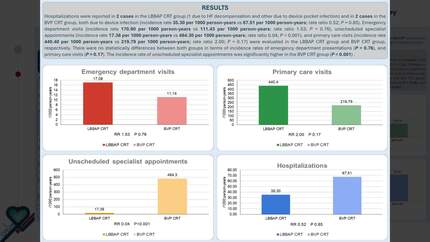
During the 12-month follow-up, hospitalizations were reported in 2 cases in the LBBAP CRT group (1 due to HF decompensation and other due to device pocket infection) and in 2 cases in the BVP CRT group, both due to device infection (incidence 35.30 per 1000 person-years vs 67.51 per 1000 person-years; rate ratio 0.52; P = 0.85).
Emergency department visits for HF or device related symptoms (incidence 170.90 per 1000 person-years vs 111.43 per 1000 person-years; rate ratio 1.53; P = 0.76), unscheduled specialist appointments (incidence 17.38 per 1000 person-years vs 484.30 per 1000 person-years; rate ratio 0.04; P < 0.001), and primary care visits (440.40 per 1000 person-years vs 219.79 per 1000 person-years; rate ratio 2.00; P = 0.17) were evaluated in the LBBAP CRT group and BVP CRT group, respectively. There were no statistically differences between both groups in terms of emergency department presentation (P = 0.76), and primary care visits (P = 0.17). Unscheduled specialist appointments (P < 0.001) were significantly more in the BVP CRT group (Table 2).
Among patients with LBBAP CRT, the incidence rate of unscheduled specialist appointments was significantly lower than with BVP CRT, without differences in primary care, hospitalizations and emergency department visits.
Contributors

I Navarro-Pelayo Torres
Author
T Fokina
Author
J M Sanchez-Moreno
Author
L Garcia-Mochon
Author
M Molina-Lerma
Author
G Gutierrez-Ballesteros
Author
M Frutos-Lopez
Author
R Pavon-Jimenez
Author
J Jimenez-Jaimez
Author
M Alvarez-Lopez
Author
You may be interested in