De novo versus staged dual chamber leadless pacemaker implantation
EP Europace Journal


Abstract
Leadless pacemakers can reduce long-term complications in patients requiring pacemaker therapy for bradycardia. Recently, a novel modular, upgradeable dual-chamber leadless pacemaker with active fixation, featuring separate atrial and ventricular devices, has become available.
To evaluate procedure time, safety, and outcomes of de novo versus staged (upgrade) implantation of a dual-chamber leadless pacemaker system with active fixation.
This retrospective single-center, single-operator analysis included consecutive patients undergoing implantation of a dual-chamber leadless pacemaker. We recorded procedure and x-ray time, procedure complications, as well as impedance, pacing threshold at 0.4 ms, and sensing from the atrial (AR) and ventricular (VR) device at implantation, one day post-implantation, and at the follow-up consultation.
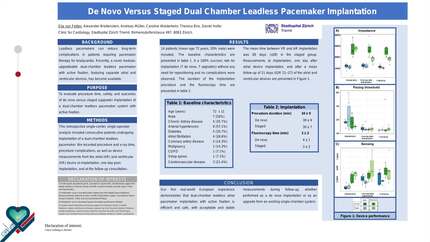
Fourteen patients (mean age 72 years, 50% male) were included, with a 100% success rate for implantation (7 de novo, 7 upgrades). No complications were observed. The mean procedure time was 30 minutes (±7) in the upgrade group and 38 minutes (±9) in the de novo group. The mean time between VR and AR implantation was 60 days (±39) in the upgrade group. Measurements at implantation, one day after atrial device implantation, and after a mean follow-up of 21 days (IQR 21–27) of the atrial and ventricular devices are presented in Figure 1.
Our first real-world European experience demonstrates that dual-chamber leadless atrial pacemaker implantation with active fixation is efficient and safe, with acceptable and stable measurements during follow-up, whether performed as a de novo implantation or as an upgrade from an existing single-chamber system.
Contributors

E Von Felten
Author
A Breitenstein
Author
A Mueller
Author
C Wiederkehr
Author
T Brix
Author
D Hofer
Author
You may be interested in