A novel approach for Bachmann's bundle pacing implantation with the lumenless, catheter-delivered pacing lead
EP Europace Journal


Abstract
Bachmann's bundle pacing (BBp), which features a morphology similar to sinus rhythm (SR) and a shortened P-wave duration (PWD), was reported to significantly reduce the incidence and permanence of atrial fibrillation compared with the right atrial appendage pacing (RAAp). The development of a catheter-delivering system using a lumenless pacing lead from Medtronic has facilitated the implantation of right atrial (RA) septal pacing, including BBp, prompting renewed interest in physiological atrial pacing. The method of BBp implantation has not been established, and we reported the effectiveness of the P-wave amplitude-guided approach for BBp implantation.
This study aimed to verify the accuracy of the P-wave amplitude-guided approach for BBp implantation and to evaluate the pacing lead parameters and ECG characteristics.
BBp implantation was attempted using the lumenless pacing lead delivered via the C315S5 delivery catheter, and the high RA septum was mapped with a unipolar amplitude recorded at the lead tip to recognize the superior vena cava (SVC)-RA junction. The amplitude was very low in SVC, and beyond the SVC-RA junction, the amplitude became sharp and high immediately, where the lead was fixed into the RA septum. After connecting the lead to the generator, the paced 12-lead ECG was evaluated on the electrophysiology lab system to determine if it met the BBp ECG criteria that were previously reported.
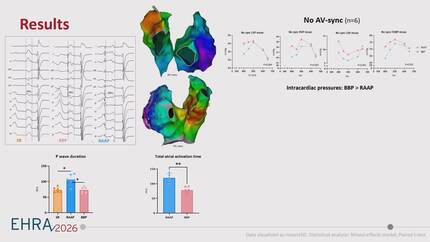
From January 2023 to January 2024, 17 patients underwent dual-chamber pacemaker implantation and attempted BBp implantation. Sixteen patients achieved successful BBp on the ECG criteria using the P-wave amplitude-guided approach, but one patient who had a history of surgical Maze and aortic valve replacement didn’t meet the BBp ECG criteria because SVC-RA junction was not clear due to low amplitude in high atrial septum and the atrial lead was fixed to lower atrial septum. At implantation, the P-wave amplitude was 2.12±0.90 mV, the atrial lead pacing impedance was 655.5±175.8 Ω, and the atrial pacing threshold was 0.70±0.31 V at 0.4 ms. The PWD during BBp was significantly shorter than the sensing PWD (110.2±11.2 ms vs 132.7±8.5 ms, p<0.001).
The P-wave amplitude-guided approach to atrial lead implantation proved effective for achieving BBp implantation with precise alignment to the ECG criteria, and BBp lead parameters were stable at implantation.
Contributors

D Yoshimoto
Author
Y Sakamoto
Author
Y Uemura
Author
R Yamaguchi
Author
H Naganawa
Author
T Suzuki
Author
You may be interested in