Mechanical and electrical synchrony correlation in left bundle branch area pacing
EP Europace Journal


Abstract
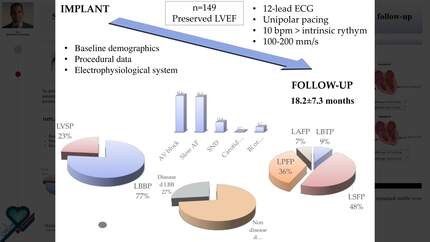
Left bundle branch area pacing (LBBAP) has shown notable benefits, largely due to enhanced electromechanical synchrony in the left ventricle (LV) when compared to traditional pacing techniques. However, the correlation between electrical and mechanical synchrony parameters remains insufficiently studied.
To assess the long-term performance of both electrical and mechanical synchrony in a cohort of patients undergoing LBBAP, with consideration of key factors like the percentage of ventricular pacing. Mechanical synchrony was evaluated using 2D echocardiographic metrics, myocardial strain, and the innovative myocardial work (MW). Electrical synchrony was assessed with established ECG criteria for LBBAP and QRS width.
Consecutive patients with successful LBBAP for bradycardia pacing and preserved left ventricular ejection fraction (LVEF) were included. At follow-up, MW and other mechanical synchrony parameters were measured alongside electrical synchrony variables. Two echocardiograms were performed with a minimum 30-minute interval: one during paced rhythm and, if feasible, one during spontaneous rhythm.
A total of 149 patients with LBBAP were analyzed: 114 with left bundle branch pacing (LBBP) and 35 with left ventricular septal pacing (LVSP). The mean follow-up was 18.2 ± 7.2 months. In univariate linear regression analysis, no significant association was observed between paced MW parameters and V6-RWPT duration, with the exception of Global Wasted Work (GWW) (β=0.174, p=0.049), nor with V1-RWPT duration. However, the interpeak interval showed a significant association with interventricular mechanical delay (IVMD) (β=0.198, p=0.048) and peak strain dispersion (PSD) (β=-0.253, p=0.013). The QRS duration, measured from the pacing spike, was correlated with paced Global Longitudinal Strain (GLS) (β=0.205, p=0.020) and paced GWW (β=0.181, p=0.031); when measured from the onset, it was associated with paced GLS (β=0.215, p=0.014) (Table 1). The average pacing percentage at follow-up was 45.1±43.8% (median 28.6%). In univariate linear regression, pacing percentage showed no significant association with paced LVEF or other MW parameters, except for paced GLS (β=-0.261, p=0.003). As a dichotomous variable, pacing percentages above 20% or 40% showed significant differences only in paced GLS (-16.8±2.5 vs. -13.8±7.6, p=0.006, and -16.8±2.6 vs. -14.1±7.3, p=0.007, respectively), with no significant differences in LVEF or baseline QRS duration at implantation.
The QRS width emerged as the electrical synchrony marker most consistently linked with long-term LV mechanical performance as assessed by myocardial strain. Additionally, both QRS width and the interpeak interval correlated with interventricular synchrony, as indicated by IVMD. Patients with higher levels of LBBAP demonstrated improved LV contractility, as reflected by GLS. Univariate linear regression analysis Mechanical synchrony and %VP
Contributors

A Estevez Paniagua
Author
S Briongos Figuero
Author
M Tapia Martinez
Author
S Jimenez Loeches
Author
A Sanchez Hernandez
Author
E Sanchez Lopez
Author
A Luna Cabadas
Author
D Heredero Palomo
Author
R Munoz Aguilera
Author
You may be interested in