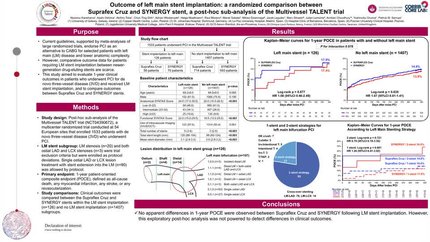
Patient characteristics and periprocedural outcomes of percutaneous coronary intervention of the left main coronary artery
European Heart Journal - Acute CardioVascular Care


Abstract
Type of funding sources: None.
Left main (LM) disease is found in 5 to 6% of all coronary angiograms. Revascularization has a class IA recommendation, but the choice of the revascularization method whether by coronary artery bypass grafting (CABG) or percutaneous coronary intervention (PCI) is currently under debate. The selection depends on patient’s characteristics (age, sex, comorbidities, frailty), as well as anatomical considerations.
We aim to describe the patients with LM disease that were treated with PCI and report their short-term outcomes in a tertiary center.
Single-center retrospective study including all patients who underwent LM PCI from 2013 to 2019. The basal characteristics were retrieved from the electronic medical records. Acute kidney injury was defined as an absolute increase in serum creatinine of ≥ 0.3 mg/dL or ≥ 1.5-fold from baseline. Type IVa myocardial infarction was assessed by the Third Universal Definition.
A total of 110 procedures were performed during the study period (
Table 1. Patient characteristics.
Figure 1. Left main PCIs over time.
There was only 1 death (0.9%) during index hospitalization. There was a high incidence of type IVa myocardial infarction (19.1%) and acute kidney injury (10%), and a low incidence of TIMI major bleeding (1.8%).
Current practice shows an increase of left main PCI over time, particularly from 2016, after the EXCEL trial results were published. This can be due to improved technical aspects such as IVUS guidance, which was used in most patients. Noticeable, almost half of the patients had a reduced ejection fraction.
Although there was a very low short-term mortality associated with the procedure (1%), as well as a low bleeding risk (4.8%), there was a high incidence of type IVa myocardial infarction (20.2%). Only 55.5% archived a complete revascularization. Despite promising immediate results in clinical practice, long term follow up will be essential to determine the future role of left main PCI.
Contributors



You may be interested in