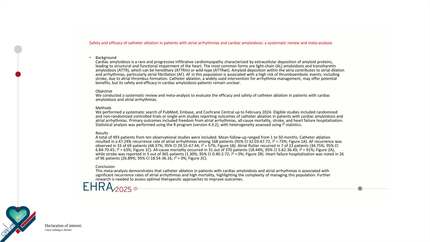
Safety and efficacy of catheter ablation in patients with atrial arrhythmias and cardiac amyloidosis: a systematic review and meta-analysis
EP Europace Journal


Abstract
Cardiac amyloidosis is a rare and progressive infiltrative cardiomyopathy characterized by extracellular deposition of amyloid proteins, leading to structural and functional impairment of the heart. The most common forms are light-chain (AL) amyloidosis and transthyretin amyloidosis (ATTR), which can be hereditary (ATTRm) or wild-type (ATTRwt). Amyloid deposition within the atria contributes to atrial dilation and arrhythmias, particularly atrial fibrillation (AF). AF in this population is associated with a high risk of thromboembolic events, including stroke, due to atrial thrombus formation. Catheter ablation, a widely used intervention for arrhythmia management, may offer potential benefits, but its safety and efficacy in cardiac amyloidosis patients remain unclear.
We conducted a systematic review and meta-analysis to evaluate the efficacy and safety of catheter ablation in patients with cardiac amyloidosis and atrial arrhythmias.
We performed a systematic search of PubMed, Embase, and Cochrane Central up to February 2024. Eligible studies included randomized and non-randomized controlled trials or single-arm studies reporting outcomes of catheter ablation in patients with cardiac amyloidosis and atrial arrhythmias. Primary outcomes included freedom from atrial arrhythmias, all-cause mortality, stroke, and heart failure hospitalization. Statistical analysis was performed using the R program (version 4.3.2), with heterogeneity assessed using I² statistics.
A total of 493 patients from ten observational studies were included. Mean follow-up ranged from 1 to 50 months. Catheter ablation resulted in a 47.24% recurrence rate of atrial arrhythmias among 168 patients (95% CI 32.03-67.72; I² = 73%; Figure 1A). AF recurrence was observed in 33 of 69 patients (48.37%; 95% CI 29.55-67.44; I² = 57%; Figure 1B). Atrial flutter recurred in 7 of 23 patients (34.75%; 95% CI 6.84-70.45; I² = 63%; Figure 1C). All-cause mortality occurred in 31 out of 370 patients (18.44%; 95% CI 5.62-36.49; I² = 91%; Figure 2A), while stroke was reported in 5 out of 365 patients (1.30%; 95% CI 0.40-2.72; I² = 0%; Figure 2B). Heart failure hospitalization was noted in 26 of 96 patients (26.89%; 95% CI 18.54-36.16; I² = 0%; Figure 2C).
This meta-analysis demonstrates that catheter ablation in patients with cardiac amyloidosis and atrial arrhythmias is associated with significant recurrence rates of atrial arrhythmias and high mortality, highlighting the complexity of managing this population. Further research is needed to assess optimal therapeutic approaches to improve outcomes.
Contributors

R Mazetto Silva Vieira
Author
E Bulhoes
Author
V L J Antunes
Author
M L R Defante
Author
L P C F Garcez
Author
E Bastos
Author
M V Pinto
Author
I Guerreiro
Author
C A G Farias
Author
P N Ximenes
Author
P A M G Sousa
Author
V M R Oliveira
Author
B V K Bueno
Author
F Fernandes
Author
F C Darrieux
Author
You may be interested in