Age-dependency performance of diagnostic prediction rules for pulmonary embolism
European Heart Journal - Acute CardioVascular Care


Abstract
Type of funding sources: None.
Age affects the performance of the diagnostic tests to rule out pulmonary embolism (PE), particularly with a decrease in specificity, leading to an overuse of computed tomography pulmonary angiography (CTPA). Current guidelines advice to consider using the age-adjusted cut-off in patients older than 50 years, but no specific recommendation is provided for very old patients.
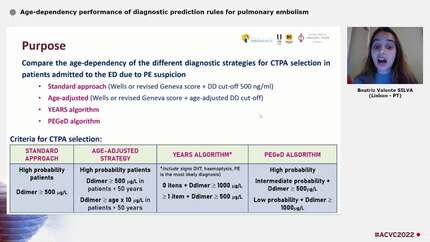
We aimed to compare the age-dependency of the diagnostic accuracy of the standard approach (based on Wells and Geneva scores combined with a D-dimer cut-off of 500 ng/mL), with three alternative strategies (age-adjusted, YEARS and PEGeD algorithms) in patients admitted to the Emergency Department (ED) due to PE suspicion.
Consecutive outpatients admitted to the ED who underwent CTPA due to PE suspicion were retrospectively evaluated. The diagnostic accuracy was calculated and compared among the different diagnostic prediction rules and stratified by age.
We included 1402 patients (mean age 69 years, 54% female). PE was confirmed in 25% (n=353), 86% occurred in patients over 50 years. Table 1 and 2 represents the sensitivity and specificity of diagnostic prediction rules stratified by age.
For all diagnostic strategies, specificity decreases with age. In patients over 80 years, the standard approach’s specificity could be as low as 8%. Compared to the standard approach, the age-adjusted strategy was associated with higher specificity over 50 years (p=0.008 for patients aged 51-60 years; p<0.001 for patients over 60 years), with similar sensitivities for patients under 70 years and a non-statistically significant decrease in sensitivity in patients over 70 years (p=0.03). YEARS and PEGeD algorithms had the highest specificities for all ages (p£0.001). Regarding sensitivity, except for patients aged between 61 and 70 years, YEARS and PEGeD showed lower sensitivity than the standard and age-adjusted approaches for all ages (p<0.001), particularly in patients under 60 years (sensitivity of 81% in patients aged between 51-60 years).
Compared to the standard approach, an age-adjusted strategy increased specificity with a non-significant decrease in sensitivity only in patients older than 70. YEARS and PEGeD algorithms had the highest specificity across all ages yet were associated with a significant decrease in sensitivity.
Sensitivity and Specificity
Contributors


J Rigueira
Author
Santa Maria University Hospital (CHULN), CAML, CCUL, Lisbon School of Medicine of the Universidade d Lisbon , Portugal

C Jorge
Author
Santa Maria University Hospital CHLN Lisbon Academic Medical Centre Lisbon , Portugal





You may be interested in