Radiofrequency catheter ablation of persistent atrial fibrillation by pulmonary vein isolation with or without left atrial posterior wall isolation: long-term outcomes of the CAPLA trial
European Heart Journal


Abstract
Posterior wall isolation (PWI) is commonly incorporated into catheter ablation (CA) strategies for persistent atrial fibrillation (AF) in an attempt to improve outcomes. In the CAPLA randomized study, adjunctive PWI did not improve freedom from atrial arrhythmia at 12 months compared with pulmonary vein isolation (PVI) alone. Whether additional PWI reduces arrhythmia recurrence over the longer term remains unknown.
In this multi-centre, international, randomized study patients with persistent AF undergoing index CA using radiofrequency were randomized to PVI + PWI vs. PVI alone. Patients underwent regular follow-up including rhythm monitoring for a minimum of 3 years after CA. Atrial fibrillation burden at 3 years after ablation was evaluated with either 28-day continuous ambulatory electrocardiogram (ECG) monitoring, twice daily single-lead ECG or from cardiac implanted device. Evaluated endpoints included freedom from any documented atrial arrhythmia recurrence after a single procedure, AF burden, need for redo CA, rhythm at last clinical follow-up, healthcare utilization metrics, and AF-related quality of life.
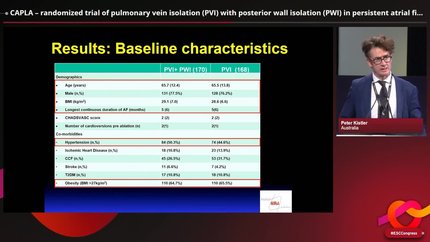
Three hundred thirty-three of 338 (98.5%) patients (mean age 64.3 ± 9.4 years, 23% female) completed 3-year follow-up, with 169 patients randomized to PVI + PWI and 164 patients to PVI alone. At a median of 3.62 years after index ablation, freedom from recurrent atrial arrhythmia occurred in 59 patients (35.5%) randomized to PVI + PWI vs. 68 patients (42.1%) randomized to PVI alone (hazard ratio 1.15, 95% confidence interval 0.88–1.51,
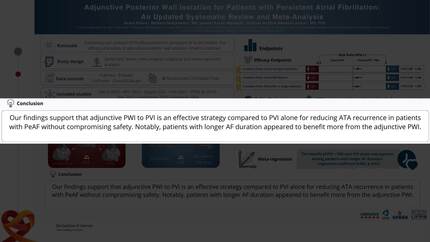
In patients with persistent AF, the addition of PWI to PVI alone at index radiofrequency CA did not significantly improve freedom from atrial arrhythmia recurrence at long-term follow-up. Median AF burden remains low and AF quality of life high at 3 years with either ablation strategy.
Contributors

Jeremy William
Author
David Chieng
Author
Annie G Curtin
Author
Hariharan Sugumar
Author
Liang Han Ling
Author

Rose Crowley
Author
Anoushka Iyer
Author

Aleksandr Voskoboinik
Author
Joseph B Morton
Author
Geoffrey Lee
Author
Alex J McLellan
Author
Rajeev K Pathak
Author
Laurence Sterns
Author
Matthew Ginks
Author
Christopher M Reid
Author
Prashanthan Sanders
Author
Jonathan M Kalman
Author

You may be interested in