Heterogeneous associations of traditional atherosclerotic risk factors and long-term complications in different arterial territories: the EPIC Norfolk prospective population cohort
European Journal of Preventive Cardiology


Abstract
Atherosclerotic risk factors have been associated with cardiovascular disease (CVD) complications in specific arterial territories. However, these observations are limited by relatively short-term follow-up (i.e. ten years) We therefore investigated longer-term associations between atherosclerotic risk factors and specific cardiovascular complications in a large cohort with ≥20 years follow-up.
We included participants from the EPIC Norfolk prospective population cohort without a history of CVD. The strength of associations between CVD risk factors (smoking, low-density lipoprotein cholesterol (LDL-c), and systolic blood pressure (SBP)) and CVD events were evaluated using a competing risks regression model. CVD events were defined as hospitalization or death due to ischemic heart disease (IHD), ischemic stroke, hemorrhagic stroke or peripheral arterial disease (PAD) including abdominal aortic aneurysm (AAA). Patients were followed-up until the first event, death (competing risk) or end of study (15-03-2018). The model was adjusted for sex, age, diabetes, HDL-c, kidney function and body mass index. LDL-c and SBP were analysed by comparing highest versus lowest quartiles. Smokers (at baseline) were compared to never-smokers. For 10.1% of participants with missing risk factor data, median imputation was used.
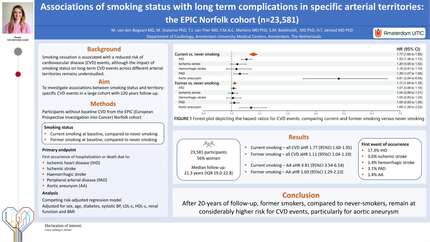
We included 23,581 participants (56% women) with a mean baseline age of 58 (IQR 51-66). During mean follow up of 22.4 years (IQR 19-23), occurrence of any CVD event was observed in 29.4% (6,926) individuals. Of these, 55.3% (4,449) were IHD, 15.0% (1,211) were ischemic stroke, 5.9% (471) were hemorrhagic stroke and 23.8% (1,920) were PAD or AAA. LDL-c was strongly associated with IHD [adjusted hazard rate (aHR) 1.67, 95% CI 1.50 - 1.85], but not significantly with hemorrhagic stroke (aHR 1.07, 95% CI 0.78 – 1.47). SBP was significantly associated with ischemic stroke (aHR 1.94, 95% CI 1.53 – 2.46), but not with hemorrhagic stroke (aHR 1.39 95% CI 0.97 – 2.00). Smoking was strongly associated with PAD/AAA (aHR 2.49, 95% CI 2.13 - 2.92), but not with ischemic stroke (aHR 1.20, 95% CI 0.95 – 1.51) and hemorrhagic stroke (aHR 1.20 95% CI 0.83 – 1.73) (Figure 1).
There is considerable heterogeneity in the associations between atherosclerotic risk factors and long-term cardiovascular complications in different arterial territories. Knowledge of these differences may assist in personalised treatment decisions and risk communication. Hazard Ratios for CVD events.
Contributors



You may be interested in