Echocardiographic analysis of male and female adolescent basketball athletes
European Journal of Preventive Cardiology


Abstract
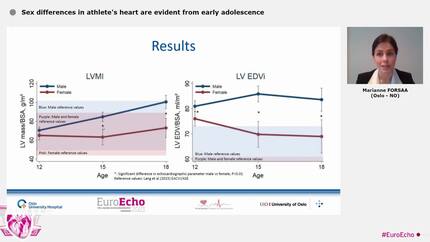
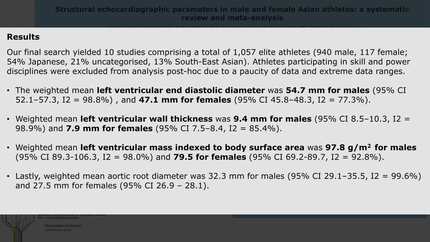
Athletes present cardiac adaptations secondary to sports training, which may include increased diameter and thickness of the left ventricle(LV). These adaptations are influenced by age, gender, ethnicity, and sport modality.In some cases, they can overlap with initial cardiomyopathy. No differences between males and females in cardiac adaptations to exercise are described in pre-pubertal individuals, showing that hormones play a significant role in that. However, there are no well-established normal values for echocardiographic(ECHO) measurements in adolescent athletes. Determining reference values(RV) in ECHO based on age and growth stage is crucial for defining cardiomyopathy and eligibility for sports participation.
Aiming to enhance diagnostic accuracy in ECHO of adolescent athletes, establish RV for measurements of the LV and their correlation with age, gender, anthropometric(ANTHRO) measures and training.
Retrospective observational cross-sectional analysis of pre-participation cardiovascular screening (PPS) on basketball athletes in Brazil.Inclusion criteria:athletes <=17yo with ECHO.Exclusion criteria: cardiac alterations, age >18yo. The analysis included a descriptive examination of correlated factors:age, height, weight, body surface area(Dubois)(BSA), and training hours. ECHO criteria considered for analysis included Aortic root(Ao), LV systolic diameter(LVSD), LV diastolic diameter(LVDD), LV fractional shortening(FS), Ventricular mass(VM), Interventricular septum thickness(IVS), and LV posterior wall thickness(LVWT).
84 basketball athletes, 43 males and 41 females, mean age 14.1y and 14.2y, weight 72.7kg and 62.5kg, height 1.80m and 1.68m, BSA 0.61 and 1.71, respectively. Training hours ranged 6-22h(M=12) for boys and 6-13.5h(M=9.6) for girls.In male adolescents, all ANTHRO variables correlated with all ECHO measurements, except for FS.Similarly, in females, all ECHO measurements, except for FS, showed a significant correlation with other variables, except for height that did not correlate with IVS, LVWT, and FS.Additionally, there was a significant association between FS and age in both genders, and between LVDD and training hours. Nomogram graphs were constructed based on allometric equations from the literature.Associations were made as depicted in Figures 1,2.
ECHO assessment of adolescent athletes should be conducted considering age, gender, BSA and training hours, as this study demonstrated that LV measurements may be influenced by these variables. Conversely, FS analysis emerged as an independent variable, varying only with age. This suggests its utility in distinguishing between physiological adaptations and pathological findings. The utilization of individualized RV based on age, gender, BSA, and FS can be valuable in preventing misinterpretations of ECHO and subsequent misdiagnoses, ultimately avoiding unnecessary disqualification for male and female adolescent athletes. Male adolescent athletes nomogram. Female adolescent athletes nomogram.
Contributors


You may be interested in