Lipid-lowering treatment pattern in chronic coronary syndrome - lower proportion of treatment observed among women during 3 years of follow-up
European Journal of Preventive Cardiology


Abstract
Lipid-lowering treatment (LLT) is one of the cornerstones in secondary prevention in patients with chronic coronary syndrome (CCS). Despite having the same recommendations for target levels of low-density lipoprotein cholesterol (LDL-C), studies have shown that women have worse control of LDL-C than men. Older age has been suggested as a significant explanatory factor.
To describe and compare the treatment pattern and target achievement of LDL-C levels in men and women managed for CCS in a primary care setting. Furthermore, to elucidate factors contributing to sex differences by examining the frequency of LDL-C assessment and LLT intensity by age.
A retrospective observational study of patients with CCS was performed in a region of Sweden comprising 390 000 inhabitants. The study population included men and women with a CCS first-time diagnosed between 2012 and 2020 and without previous myocardial infarction. The CCS diagnosis was based on the combination of an international classification diagnosis code (ICD-10) of angina and coronary artery disease confirmed by either a non-invasive or an invasive investigation. Data on clinical measurements after inclusion were collected from the electronic health records. Target levels were LDL-C <1.8 mmol/L (2012-2015) and LDL-C <1.4 mmol/L (2015-2020) and systolic blood pressure (SBP) <140 mmHg. Data were stratified by sex and age categories (<60, 60-<70, 70-<80, ≥80 years). Measurement of blood pressure (BP) was used as a proxy for a healthcare visit.
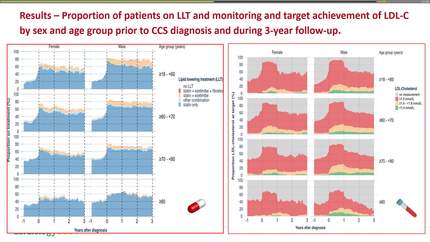
Median age was 68 (interquartile range [IQR], 62-74) and 70 (IQR, 63-76) years in men (N=1037) and women (N=415), respectively. Compared with men, women were less often treated with LLT and less likely to receive combination with a statin and ezetimibe (Figure 1). A larger proportion of women was not treated with any LLT. In all age subgroups, a decline in LLT use in women compared to men was observed over time. Assessment of LDL-C decreased markedly after the first year of follow-up irrespective of sex (assessment of LDL-C was 67.7% and 50.9% at year one and three, respectively). In both men and women, target achievement of LDL-C was low and decreased during follow-up (Figure 2). Regardless of sex, measurements and target achievement of BP were monitored more frequently than those of LDL-C levels.
Women were less often and less aggressively treated with LLT than men, on average. Although most patients with CCS are in contact with healthcare professionals for BP monitoring, little or no actions seem to be taken to improve lipid management.
Contributors



You may be interested in