Prognostic evaluation of ST-segment elevation acute myocardial infarction according to lung ultrasound in the acute phase
European Heart Journal - Acute CardioVascular Care


Abstract
Type of funding sources: Foundation. Main funding source(s): JC-M received an Original Research Projects Grant from the Catalan Society of Cardiology and LR-S received Scholarship for Training and Research from the Association of Ischemic Heart Disease and Cardiological Critical Care of the Spanish Society of Cardiology.
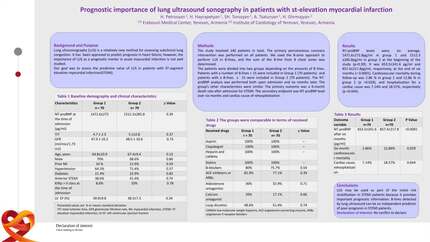
Lung ultrasound (LUS) has emerged as a useful diagnostic and prognostic tool in heart failure (HF) and has shown promise in risk stratification for ST-segment elevation myocardial infarction (STEMI) in the acute phase. These studies consistently indicate that the degree of pulmonary congestion, assessed by the number of B-lines on LUS, is significantly associated with a worse prgnosis during hospitalization and short-term follow-up in STEMI patients. However, this prognostic value has mainly been evaluated during hospital admission or a few days after discharge without a long-term follow-up.
To assess the prognostic value of LUS at one year in patients admitted for STEMI.
In a prospective multicenter cohort study involving STEMI patients, an independent operator performed LUS during the first 24 hours after revascularization and offline B-line counting was conducted. LUS results were assessed both as a categorical [wet (at least one site with ³3 B-lines)/dry lung] and continuous variable (total number of B-lines). The primary endpoint was a composite of death or hospitalization for HF, acute coronary syndrome, or stroke within one year.
A total of 173 patients were included. The composite endpoint occurred in 13.7% of the patients over a median follow-up of 368 days. LUS was able to predict the composite outcome with hazard ratios (HR) of adjusted hazard ratios of 4.85 (95% CI 2.79-8.43) for having a wet lung and 1.13 (95% CI 1.09-1.18) for each B-line. After and adjustment for sex, age, chronic kidney disease, previous atrial fibrillation, Killip class and left ventricular ejection fraction HR was 1.72 (95% CI 0.91-3.28) for having a wet lung and 1.06 (95% CI 1.00-1.11) for each B-line.
Detecting B-lines on LUS predicts adverse events at one year in STEMI patients. Kaplan-Meier curves
Contributors

C Simon-Ramon
Author
L Rodriguez-Sotelo
Author

T Giralt-Borrell
Author
A Izquierdo-Marquisa
Author
M Cainzos-Achirica
Author
H Tizon-Marcos
Author
M Rivas-Lasarte
Author
N Ribas-Barquet
Author
M Vidal-Burdeus
Author
You may be interested in