Ablation characteristics associated with steam pops in ablation index-guided radiofrequency ablation of atrial fibrillation
EP Europace Journal


Abstract
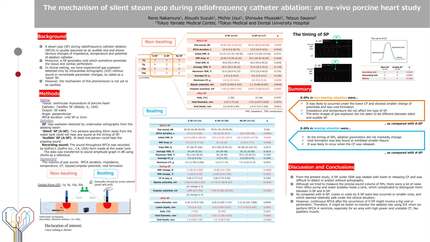
Steam pops present a significant concern during radiofrequency (RF) ablation of atrial fibrillation (AF). It is crucial to analyse the incidence and ablation characteristics associated with steam pops. This study aims to investigate the occurrence and potential predictors of steam pops.
This study included 3263 patients with AF who underwent RF ablation. Patients with paroxysmal AF received bilateral circumferential pulmonary vein (PV) ablation, while those with persistent AF underwent additional linear ablation. The ablation parameters at the sites of steam pops were compared to those at adjacent anatomical locations. A total of 81 steam pops (2.5%) with one pericardial tamponade were recorded. Steam pops were observed at liner ablation sites: 6 (0.4%) at the mitral isthmus, 16 (0.9%) at the tricuspid isthmus (CTI), and 7 (0.5%) along the roofline. The most common sites of steam pops were the anterior edge of the left superior PV and the inferior vena cava side of the CTI. The impedance drop was significantly higher (18.2 ± 9.5 Ω vs. 13.5 ± 4.8 Ω,
The incidence of steam pops during ablation of AF is infrequent. Impedance drop is the only ablation parameter that could predict the occurrence of steam pops.
Contributors

Xue-Si Wang
Author
Ze-Yang Wu
Author
Qi Wu
Author
De-Yong Long
Author
Cai-Hua Sang
Author
Chen-Xi Jiang
Author
Wei Wang
Author
Xin Zhao
Author
Chang-Yi Li
Author
Rong-Hui Yu
Author
Nian Liu
Author
Song-Nan Li
Author
Xiao-Xia Liu
Author
Xue-Yuan Guo
Author
Song Zuo
Author
Meng-Meng Li
Author
Tong Liu
Author
Wen-Li Dai
Author
Ming-Yang Gao
Author
Chang-Qi Jia
Author
Man Ning
Author
Li Feng
Author
Wen-He Lv
Author
Yu-Kun Li
Author
Xiao-Ying Liu
Author
Zhuo-Hang Du
Author
Jia-Lin Li
Author
Xin-Ru Li
Author
Jian-Zeng Dong
Author
Chang-Sheng Ma
Author
You may be interested in