Central venous oxygen saturation as an early marker of systemic inflammatory response syndrome and predictor of outcome in cardiogenic shock
European Heart Journal - Acute CardioVascular Care


Abstract
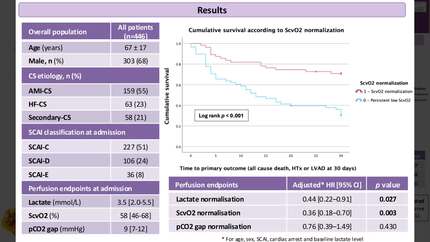
Patients with cardiogenic shock (CS) can develop systemic inflammatory response because of the cytokine storm, particularly those with higher SCAI stage. Central and mixed oxygen venous saturation (SvO2/ScvO2), are early markers of hypoperfusion: during cardiac output (CO) reduction, oxygen extraction increases and SvO2/ScvO2 decrease; in case of SIRS oxygen extraction is impaired and SvO2/ScvO2 increase.
Our study aims to evaluate the role of ScvO2 as an early marker of SIRS development and an outcome predictor in CS.
We identified 46 CS patients admitted to our Cardiology Intensive Care Unit from May 2022 to September 2023: those who survived > 24h (n 41) were divided into 2 groups according to the presence of SIRS at 24h (International Consensus Sepsis-3 criteria). ScvO2 = 60% on admission was identified as the predictive cut-off value for the development of SIRS at 24h (sensitivity 82%, specificity 93%). Then the whole population (n 46) was divided according to the admission ScvO2 value: ScvO2 ≥ 60% (n 27) and < 60% (n 19) and their clinical outcomes were assessed.
Patients with ScvO2 ≥ 60% and ScvO2 < 60% presented similar baseline characteristics. 96% of the patients in the group ScvO2 ≥ 60% developed SIRS at 24h from admission compared to the group ScvO2 < 60% (p < 0.001). We found no differences in inflammatory markers between the two groups (table 1). No difference in serum lactates at admission (6.93 vs 5.16 mmol/L, p 0.172) was evidenced between the two groups, whereas 12-hour lactates were significantly higher in the ScvO2 ≥ 60% group (6.37 vs 3.73 mmol/L, p 0.029) and peak serum lactates showed a tendency towards statistical significance (10.11 vs 6.83 mmol/L, p 0.071). Patients with ScvO2 ≥ 60% had higher peak serum creatinine (3.29 vs 2.08 mg/dl, p 0.026), lower glomerular filtration rate nadir (eGFR 29.74 vs 46.96 ml/min/1.73m2, p 0.005), platelet count nadir (114,73x10⁹/L vs 152,68 x10⁹/L, p 0.054) haemoglobin count nadir (9,00 vs 9,89 g/dl, p 0,072). At 24 hours from admission, vasoactive-inotropic score (VIS) was higher in the ScvO2 ≥ 60% group (35.5 vs 25.07 p 0.078), as was the need for mechanical support implantation/escalation (82% vs 42%, p 0.006). In-hospital cardiovascular and all-cause mortality rates were double in the ScvO2 ≥ 60% group (30% vs 15%, p 0.501, and 37% vs 21%, p 0.246).
ScvO2 is expected to be low in CS patients and it is known that SIRS portends worse prognosis. In our study, ScvO2 ≥ 60% was identified as a sensitive and specific marker for the development of SIRS at 24h: inappropriately high value of ScvO2 was not only a marker of the development of SIRS but also of a more serious shock state with higher serum lactate, renal impairment and need of pharmacological and mechanical supports. Further prospective studies will confirm the role of ScvO2 and the most appropriate cut-off for defining SIRS and prognosis in CS population. Design of the study Outcomes based on ScvO2
Contributors

You may be interested in