Management of ventricular septal defect. an unsolved problem
European Heart Journal - Acute CardioVascular Care


Abstract
In recent years, the incidence of ventricular septal defect (VSD) resulting from an acute myocardial infarction (AMI) has decreased due to primary angioplasty. Nevertheless, it remains associated with poor prognosis and high mortality. Currently, preoperative management, timing and optimal surgical technique remain undefined.
To characterize patients with VSD following an AMI and to analyze the outcomes of our clinical and surgical strategy, with a particular focus on the perioperative management of mechanical circulatory support.
This retrospective study included 26 patients admitted to a cardiovascular intensive care unit with VSD between 2015 and 2024. Clinical, laboratory and surgical variables, as well as hospital length of stay and mortality, were analyzed.
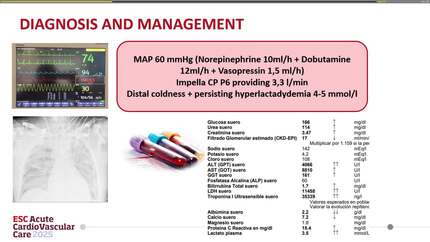
In our cohort, the mean age was 68.12 years (CI 63.85-70.8), 17 (65.4%) were male, 13 had (50%) diabetes. STEMI occurred in 20 (79.9%) patients, being the right coronary artery responsible in 11 (47.8%). Mean lactate and troponin levels were 4.10 (SD 3,6) and 1089 (SD 21658), respectively. Clinical and laboratory characteristics are shown in Figure 1.
In respect of preoperative management, we used PAC in 18 (69.2%) and CS (CI <2.2 L/min/m²) was observed in 18 (70.8%) cases. Invasive mechanical ventilation (IMV) was required prior to surgery in 17 patients (65.4%), with an average duration of 3.5 days. Mechanical circulatory support (MCS) was used in 23 patients (88.5%), 9 received IABP, 1 received ECMO alone (4.3%) and the other 13 patients (56.5%) IABP and ECMO. The mean duration of MCS was 4.2士3.1 days.
Regarding surgical intervention, 12 (57.1%) David-procedure were performed, 4 (19.0%) apical amputations, 3 (14.28%) double-patch repair without ventriculotomy and 2 (9.5%) Daggett procedures. CABG was performed in 6 cases (28.6%) and valve replacement in 3 (14.3%). Reoperation was required in 7 patients (35%) (bleeding (4, 19%) and persistent VSD (3, 14.28%)). 5 patients (19.2%) did not undergo repair surgery, 4 due to futility and 1 for being in refractory CS.
Overall in-hospital mortality was 73.1% (19). Nevertheless, analyzing patients who were someted to surgery the mortality was 63.3% (14). Univariate analysis indicated that elevated lactate (p<0,01), creatinine levels (p<0,04) and the duration of IMV (p<0,01) were significantly associated with higher mortality (Figure 2). There is not significant association between patients with ECMO nor in the global cohort or the subgroup analysis of surgically treated patients (p>0,05)
In our population patients with VSD following AMI have high in-hospital mortality despite an increasing use of MCS for cardiogenic shock perioperative management. Perioperative need of IMV and the duration of the therapy definitely influences the prognosis. We still need to find the best optimal perioperative management to reduce high mortality in these patients.
Contributors


You may be interested in