Malondialdehyde-specific natural IgM inhibit NETosis triggered by culprit site–derived extracellular vesicles from myocardial infarction patients
European Heart Journal


Abstract
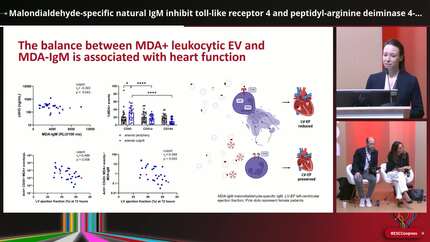
Neutrophil extracellular traps (NETs) trigger atherothrombosis during acute myocardial infarction (AMI), but mechanisms of induction remain unclear. Levels of extracellular vesicles (EV) carrying oxidation-specific epitopes (OSE), which are targeted by specific natural immunoglobulin M (IgM), are increased at the culprit site in AMI. This study investigated EV as inducers of NETosis and assessed the inhibitory effect of natural anti-OSE–IgM in this process.
Blood from the culprit and peripheral site of ST-segment elevation myocardial infarction (STEMI) patients (
CD45+ MDA+ EV and NET markers were elevated at the culprit site. Extracellular vesicles induced neutrophil activation and NET formation via TLR4 and PAD4, and mice injected with EV showed increased NETosis. Malondialdehyde-specific IgM levels were inversely associated with citH3 in STEMI patient blood. An MDA-specific IgM inhibited EV-induced NET release
Culprit site–derived EV induce NETosis, while MDA-specific natural IgM inhibit this effect, potentially impacting outcome after AMI.
Contributors


Taras Afonyushkin
Author
Adrienne Aszlan
Author
Soreen Taqi
Author
Thomas Koller
Author

Florentina Porsch
Author

Smriti Sharma
Author
Thomas Scherz
Author
Andreas Spittler
Author
Maximilian Haertinger
Author
Thomas M Hofbauer
Author
Maria Ozsvar-Kozma
Author
Veronika Seidl
Author
Dietrich Beitzke
Author
Marcus Krueger
Author
Christoph Testori
Author


You may be interested in