Evaluation of right ventricular pacing-induced coronary microvascular dysfunction using guide wire-based sensor technology: a case report
European Heart Journal - Case Reports


Abstract
The diagnosis of ischaemic non-obstructive coronary artery disease is crucial for the differential diagnosis of chest pain. However, the pathophysiology of chest pain and evaluation of coronary microcirculation in patients with right ventricular pacing (RVP) have not been sufficiently reported.
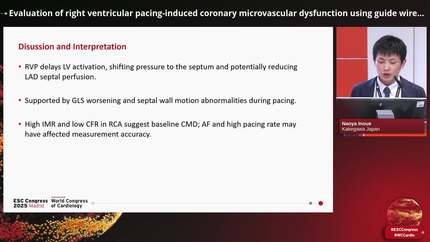
The patient was a 53-year-old woman who underwent dual-chamber pacemaker implantation because of sinus node dysfunction. She experienced chest pain before pacemaker implantation; however, the frequency and severity of her chest pain increased after the implantation. She was referred for the evaluation of coronary microvascular dysfunction (CMD). Coronary angiography revealed no significant stenosis of the epicardial vessels. Subsequent evaluation of CMD showed that while the index of microcirculatory resistance [normalized index of microcirculatory resistance (IMR)] in the left anterior descending artery (LAD) was 19 U during the native rhythm, an increase in IMR (normalized IMR: 27 U) was observed during RVP.
Right ventricular pacing may not only induce left ventricular dyssynchrony due to non-physiological excitation propagation but may also provoke CMD in the LAD territory, particularly in the septal branches, which could contribute to pacing-induced structural CMD and chest pain. However, RVP may well be a contributing but not exclusively a factor of CMD.
Contributors

Takashi Mishina
Author
Naoya Inoue
Author
Shuji Morikawa
Author
Felix Wiedmann
Author
Lorenzo Caratti di Lanzacco
Author
Doralisa Morrone
Author
Nikolaos Spinthakis
Author
You may be interested in