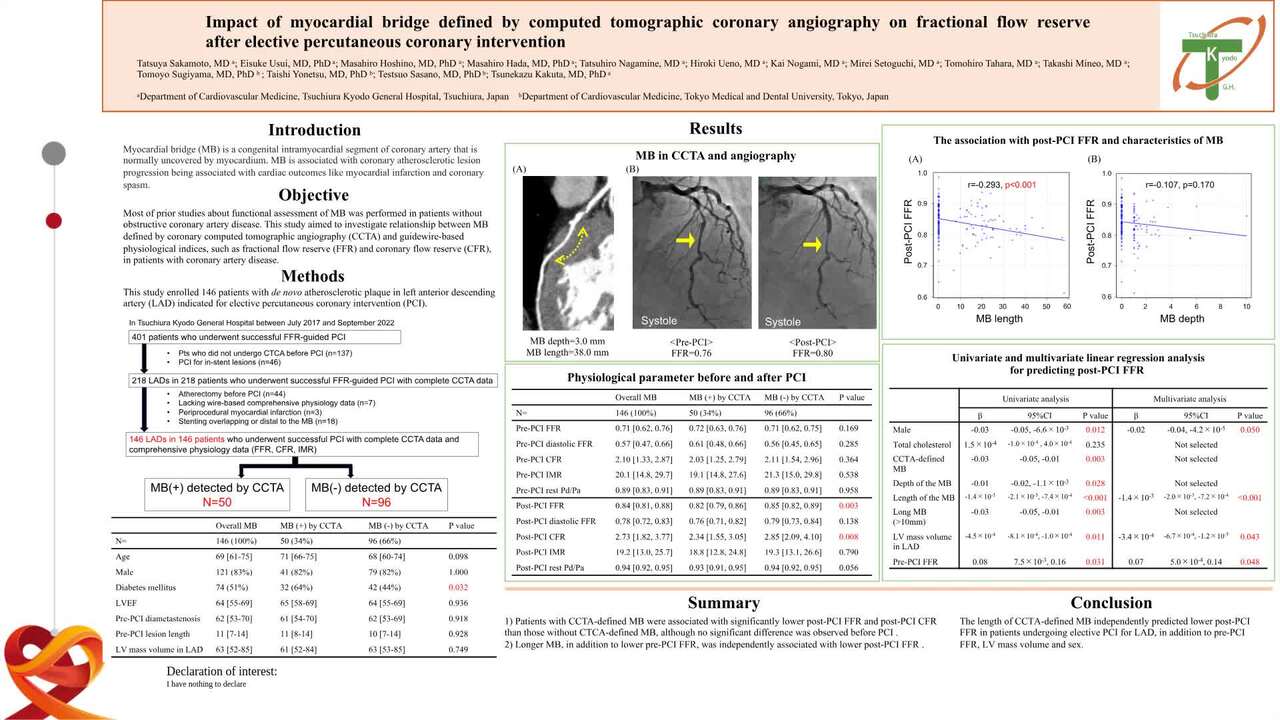
Prognostic value of noninvasive coronary flow reserve during dobutamine provocation in patients with myocardial bridging in long-term follow-up
European Heart Journal - Cardiovascular Imaging


Abstract
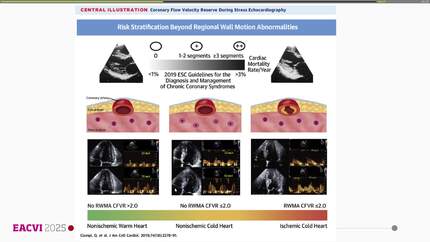
Recent studies showed that noninvasive coronary flow velocity reserve (CFR) measurement during inotropic stimulation with dobutamine (DOB) provides more reliable functional evaluation of myocardial bridging (MB). Additionally, a CFR cut-off value <2.1 during DOB was found to be the most reliable for the identification of MB associated with stress-induced myocardial ischemia. However, studies of clinical outcomes during long-term follow-up associated with the use of noninvasive CFR are lacking. The aim of the study was to evaluate major adverse cardiac events (MACE: unstable angina [UA] that required hospitalization, non-fatal myocardial infarction [MI], and all-cause mortality) associated with established CFR ischemic threshold during long-term follow-up.
This study included 79 patients (54 males, mean age 55±10 years) with angiographic evidence of isolated MB on the left anterior descending artery and systolic compression ≥50% diameter stenosis assessed by quantitative coronary angiography. CFR at peak DOB (30-40 μg/kg/min) was measured in the distal segment of LAD, and patients were divided into two groups according to previously validated CFR threshold of <2.1. Patients were monitored (ambulatory, hospital, and by telephone) for the occurrence of MACE over a median follow-up 8.2 years (interquartile range: 4.4 to 9.2 years) after enrollment.
A total of 22 events were occurred in 20 patients: UA that required hospitalization in 20 patients (25%), nonfatal-MI in 1 patient (1.2%), and death in 1 patient (1.2%). The group of MB-patients with CFR <2.1 had 3.9 times higher rate of MACE during long-term follow-up in comparison to the group of MB-patients with CFR >2.1 (HR 3.90; 95% CI: 1.673-9.072; p=0.002). This was mainly driven by a 4-fold higher rate of UA that required hospitalization (HR 4.33; 95%CI: 1.773-10.589; p<0.001).
In MB-patients, CFR <2,1 during DOB provocation is associated with a significantly higher rate of UA that required hospitalization, whereas long-term prognosis with respect to death and nonfatal-MI was similar in both groups.
Contributors





You may be interested in