Association of the right ventricular ejection adjusted by the regurgitant volume with outcomes in patients with secondary tricuspid regurgitation - a three-dimensional echocardiographic study
European Heart Journal - Cardiovascular Imaging


Abstract
In patients with secondary tricuspid regurgitation (STR), the chronic volume overload caused by the regurgitant volume (RegVol) may lead to an overestimation of the right ventricular (RV) systolic function when evaluated using traditional echocardiographic parameters.
We sought to overcome this limitation in patients with STR by investigating whether the effective RV ejection fraction (eRVEF) – which is the RVEF calculated after subtracting the RegVol from the total RV stroke volume – has a stronger association with outcomes compared to tricuspid annular plane systolic excursion (TAPSE), fractional area change (FAC), RV free-wall strain (RV-FWS), and RVEF.
The study included consecutive patients with a first diagnosis of STR (ranging from mild to severe) undergoing complete two-, three-dimensional (3D), and Doppler echocardiography. eRVEF was computed as forward RV stroke volume (fRVSV)/ RV end-diastolic volume, where fRVSV was obtained by subtracting the STR RegVol obtained with the PISA method from the total RVSV obtained with 3D echocardiography. The endpoint was a composite of heart failure hospitalization (HHF) and all-cause death.
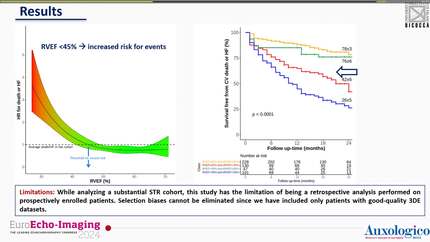
513 patients (mean age 75±13 years, 53% female, 39% atrial STR, 58% severe STR) were included in the final cohort. After a mean follow-up of 18±15 months, 195 patients (38%) reached the composite endpoint (97 HHF and 98 all-cause deaths). At time-dependent receiver operating characteristic analysis, eRVEF (AUC 0.72, 95%CI 0.68-0.77) demonstrated a stronger association with outcome than TAPSE (AUC 0.64, 95%CI 0.59-0.69, p= 0.01), FAC (AUC 0.55, 95%CI 0.50-0.60, p<0.001), RV-FWS (AUC 0.63, 95%CI 0.58-0.68, p= 0.003), and RVEF (AUC 0.65, 95%CI 0.59-0.70, p=0.006) (Figure 1). The spline curve of mortality risk showed that the cut-off value of eRVEF associated with an excess event rate was 20%, whereas, for the conventional RVEF, it was 45%. By separating the study population into 4 groups according to eRVEF value (higher and lower than 20%) and RVEF value (higher and lower than 45%), the highest cumulative rate of events was observed in the patients with both eRVEF and RVEF reduced values (event rate at 2 years 74 ± 5%, log-rank <0.0001) (Figure 2). Interestingly, patients with eRVEF<20% and RVEF≥45% had a significantly worse outcome than patients with eRVEF≥20% and RVEF<45%. At univariate Cox regression analysis, eRVEF <20% was associated with a 3-fold increased risk of experiencing the composite outcome [hazard ratio (HR): 3.54 [2.61-4.79], p<0.0001]. On three different models of multivariable Cox regression analysis, eRVEF as a continuous variable remained independently associated with the composite outcome (HR: 0.96; 95% CI= 0.94 -1.0; p<0.001).
eRVEF showed a stronger association with the composite endpoint of all-cause mortality and HHF compared to the conventional echocardiographic indices of RV function in a large group of STR patients.
Contributors


M Tomaselli
Author


C Baratto
Author

C Delcea
Author
Colentina Clinical Hospital Carol Davila University of Medicine and Pharmacy Bucharest , Romania
A Rota
Author