Anticoagulation in device-detected atrial fibrillation with or without vascular disease: a combined analysis of the NOAH-AFNET 6 and ARTESiA trials
European Heart Journal


Abstract
The optimal antithrombotic therapy in patients with device-detected atrial fibrillation (DDAF) is unknown. Concomitant vascular disease can modify the benefits and risks of anticoagulation.
These pre-specified analyses of the NOAH-AFNET 6 (
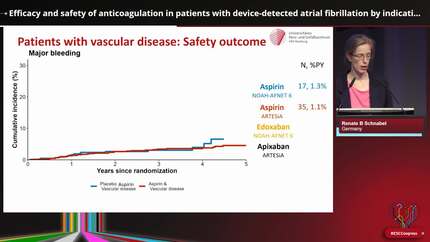
In patients with vascular disease (NOAH-AFNET 6, 56%; ARTESiA, 46%), stroke, myocardial infarction, systemic or pulmonary embolism, or cardiovascular death occurred at 3.9%/patient-year with and 5.0%/patient-year without anticoagulation (NOAH-AFNET 6), and 3.2%/patient-year with and 4.4%/patient-year without anticoagulation (ARTESiA). Without vascular disease, outcomes were equal with and without anticoagulation (NOAH-AFNET 6, 2.7%/patient-year; ARTESiA, 2.3%/patient-year in both randomized groups). Meta-analysis found consistent results across both trials (
Patients with DDAF and vascular disease are at higher risk of stroke and cardiovascular events and may derive a greater benefit from anticoagulation than patients with DDAF without vascular disease.
Contributors

Ulrich Schotten
Author
Marco Alings
Author
Susanne Sehner
Author
Tobias Toennis
Author

Panos Vardas
Author
Christopher B Granger
Author
Antonia Zapf
Author
Renato D Lopes
Author

Jeff S Healey
Author

Juan Benezet-Mazuecos
Author

William F McIntyre
Author
Alexander Fierenz
Author
Shun Fu Lee
Author
Andreas Goette
Author

Emanuele Bertaglia
Author
Alexander P Benz
Author
Gregory Chlouverakis
Author
David H Birnie
Author
Wolfgang Dichtl
Author
Carina Blomstrom-Lundqvist
Author

A John Camm
Author
City St George's University of London London , United Kingdom of Great Britain & Northern Ireland
Julia W Erath
Author
Emmanuel Simantirakis
Author
Valentina Kutyifa
Author
Gregory Y H Lip
Author
Philippe Mabo
Author

Lena Rivard
Author
You may be interested in