Long-term aspirin adherence following myocardial infarction and risk of cardiovascular events
European Heart Journal - Quality of Care and Clinical Outcomes


Abstract
Aspirin is considered mandatory after myocardial infarction (MI). However, its long-term efficacy has been questioned. This study investigated the effectiveness of long-term aspirin after MI.
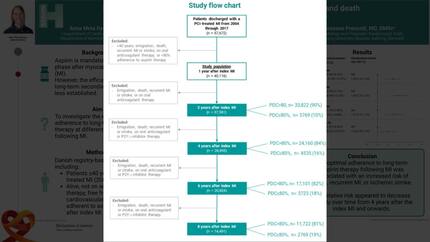
Patients ≥40 years with MI from 2004 to 2017 who were adherent to aspirin 1 year after MI were included from Danish nationwide registries. At 2, 4, 6, and 8 years after MI, continued adherence to aspirin was evaluated. Absolute and relative risks of MI, stroke, or death at 2 years from each time point were calculated using multivariable logistic regression analysis with average treatment effect modelling standardized for age, sex, and comorbidities. Subgroup analyses were stratified by sex and age > and ≤65 years. Among 40 116 individuals included, the risk of the composite endpoint was significantly higher for non-adherent patients at all time points. The absolute risk was highest at 2–4 years after MI for both adherent [8.34%, 95% confidence interval (CI): 8.05–8.64%] and non-adherent patients (10.72%, 95% CI: 9.78–11.66%). The relative risk associated with non-adherence decreased from 4 years after index-MI and onwards: 1.41 (95% CI: 1.27–1.55) at 4–6 years and 1.21 (95% CI: 1.06–1.36) at 8–10 years (
Non-adherence to long-term aspirin was associated with increased risk of MI, stroke, or death, but not in women or individuals >65 years. The risk decreased from 4 years after MI with near statistical significance.
Contributors

Anna Meta Dyrvig Kristensen
Author
Manan Pareek
Author
Kristian Hay Kragholm
Author
John William McEvoy
Author
Christian Torp-Pedersen
Author
Eva Bossano Prescott
Author
You may be interested in