Post-prandial acyl ghrelin infusion in heart failure patients increases gastric emptying rate
European Heart Journal


Abstract
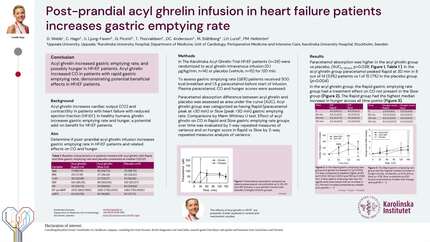
Acyl ghrelin (ghrelin) increases cardiac output (CO) and contractility in patients with heart failure with reduced ejection fraction (HFrEF). In healthy humans, ghrelin increases gastric emptying rate (GER) and hunger, a potential add-on benefit for HFrEF patients suffering from cachexia with symptoms of delayed gastric emptying and loss of appetite.
Determine if post-prandial ghrelin infusion increases GER and hunger in HFrEF patients; compare to CO.
This study was a component of a double-blind placebo-controlled trial of acyl ghrelin vs. placebo in HFrEF. Patients (n=29) arrived fasted and received a 500 kcal breakfast and 1.5 g paracetamol. They next received placebo (vehicle, n=15) or ghrelin infusion (0.1 µg/kg/min, n=14) for 120 min. Blood was tapped for plasma at 0, 30, 60, 120 and 150 min into the meal. Plasma concentration of paracetamol was measured to assess GER of a liquid bolus. Hunger scores and CO were recorded. Mann-Whitney rank sum test was used for statistics.
Paracetamol peaked at 30 min in 8 of 14 (57%) in the ghrelin treatment group versus 1 of 15 (7%) in the placebo group (P=0.004, Fig 1). Remaining patients peaked at later time points. There were no anomalous peaks at 0 min baseline or 2880 min (2 days). The ghrelin treatment group data was segregated into rapid (peak at 30 min, n=8) and slow (peak >30 min, n=6) GER subgroups. The rapid subgroup had a ghrelin treatment effect on CO (one-way repeat measures) (P<0.001, Fig 2). Baseline (t=0) CO for the rapid GER subgroup was 4.06 ±1.41 L/min (median ±SD) and 3.95 ±0.62 L/min for the slow GER subgroup (P=0.31). Data points shown are median ± SEM, each patient normalized to own baseline (100%); * P<0.05, ** P<0.01, *** P<0.001, pairwise comparison to baseline. Hunger gradually increased. The greatest increase in hunger was at 150 min, at which time median fold increase in hunger relative baseline was 1.6 (placebo), 1.7 (ghrelin, slow GER) and 2.3 (ghrelin, rapid GER). These hunger differences between groups did not reach significance. However, this trend was consistent with ghrelin induction of hunger, especially in those with potent GER and CO responses.
Ghrelin increases GER, and potentially hunger, in HFrEF patients in addition to increasing CO. Some HFrEF patients may benefit from this add-on effect. Time of paracetamol peak. Cardiac output.
Contributors



You may be interested in