Reversibility of precapillary pulmonary hypertension and outcomes after heart transplantation bridged with left ventricular assist devices: insight from the UNOS
European Heart Journal


Abstract
In light of the updated lowered threshold for diagnosing pulmonary hypertension (PH), the reversibility of precapillary PH with left ventricular assist device (LVAD) and the associated post heart transplantation (HT) outcomes remain unclear.
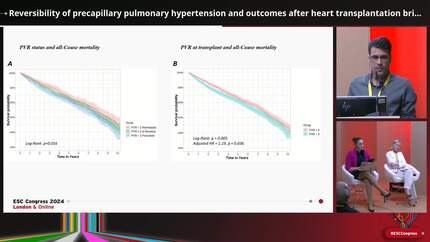
Using data from the United Network for Organ Sharing database, we aimed to investigate predictors of persistent precapillary PH in HT recipients bridged with LVAD, and examine the interrelated post-HT survival, using the updated pulmonary vascular resistance (PVR) cutoff of >2 WU for precapillary PH.
Among 2169 HT recipients bridged with LVAD, 1299 had PVR>2 at baseline; 551 (42.4%) of whom normalized their PVR≤2 and 748 (57.6%) remained with elevated PVR>2 after LVAD implantation. Female sex (adjusted odds ratio [aOR] 2.22, 95% confidence interval [CI]:1.61-3.07, p<0.001) and inotropes-treatment at-listing (aOR 1.31, 95% CI: 1.03-1.66, p=0.028) were associated with persistently elevated PVR post LVAD. Conversely, longer duration of LVAD support (aOR 0.74, 95% CI: 0.65-.84, p<0.001) and use of HeartMate 2 (aOR 0.74, CI: 0.59-0. 93, p=0.011) were protective against persistently elevated PVR post-LVAD. Persistently elevated PVR >2 post-LVAD was associated with increased risk of death compared to those who normalized their PVR (adjusted hazard ratio [aHR] 1.26, 95% CI: 1.01-1.57, p=0.037). However, normalized PVR post-LVAD group had comparable survival to those with PVR≤2 at baseline (aHR 0.76, 95% CI: 0.57-1.02, p=0.07).
Many HT recipients bridged with LVAD remain with PVR>2 post-LVAD implantation, which is associated with increased risk of death post-HT compared to patients with normalized PVR post-LVAD.
Contributors

R Kanneganti Perue
Author
F Khalil
Author
O Regev
Author
S Kushwaha
Author
A Briasoulis
Author
R Asleh
Author
You may be interested in