Derivation and validation of a multicenter model to identify candidates for advanced HF therapies with high potential to achieve post-LVAD reverse cardiac remodeling
European Heart Journal


Abstract
A subset of advanced heart failure (HF) patients can experience significant improvement in their cardiac structure and function while on left ventricular assist device (LVAD) support, which is among the prerequisites for LVAD weaning.
We sought to develop and validate a predictive personalized tool to identify candidates for advanced HF therapies with a high potential to achieve significant improvement in myocardial structure and function post-LVAD. This tool can aid clinicians and patients considering advanced HF therapies options.
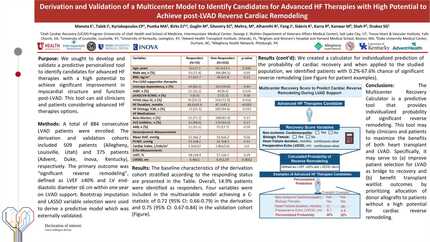
A total of 884 consecutive LVAD patients were enrolled. The derivation and validation cohorts included 509 patients (from three institutions) and 375 patients from another four institutions), respectively. The primary outcome was "significant reverse remodeling", defined as left ventricular ejection fraction (LVEF) ≥40% and LV end-diastolic diameter ≤6 cm within one year on LVAD support. Bootstrap imputation and LASSO variable selection were used to derive a predictive model which was externally validated.
Patients were predominantly white (78%), male (80.1%), 57±14 years old. Overall, 12.8% patients were identified as responders. Four variables associated with reverse remodeling were included in the multivariable model achieving a C-statistic of 0.72 (95% CI: 0.66-0.79) in the derivation and 0.75 (95% CI: 0.67-0.84) in the validation cohort (Figure). We created a calculator for individualized prediction of the probability of cardiac recovery and when applied to the studied population, we identified patients with 0.2%-67.6% chance of significant reverse remodeling (see Figure for patient example).
The Multicenter Recovery Calculator is a predictive tool that provides individualized probability of significant reverse remodeling. This tool may help clinicians and patients to maximize the benefits of both heart transplant and LVAD. Specifically, it may serve to (a) improve patient selection for LVAD as bridge to recovery and (b) benefit transplant waitlist outcomes by prioritizing allocation of donor allografts to patients without a high potential for cardiac reverse remodeling.
Contributors

I Taleb
Author
C Kyriakopoulos
Author
M Psotka
Author
E Birks
Author
M Guglin
Author
S Silvestry
Author
M Mehra
Author
R Alharethi
Author
J Fang
Author
K Sideris
Author
R Karra
Author
M Kanwar
Author
P Shah
Author

You may be interested in