CMR predictors of acute right heart failure after LVAD implantation
European Heart Journal


Abstract
Acute right heart failure (RHF) is one of the most dangerous complications after placement of left ventricular assisted device (LVAD), having a significant impact on prognosis, and is estimated to be around 3 to 35%. Even though right ventricular evaluation with hemodynamical and echocardiographic measurements is a key aspect prior to LVAD implantation, prediction of RHF remains a challenge in daily clinical practice.
To identify cardiac magnetic resonance (CMR) predictors of RHF after LVAD placement.
We retrospectively enrolled patients referred to our centre for implantation who also underwent CMR scan prior to LVAD implantation. Acute RHF was defined according to Mechanical Circulatory Support Academy Research Consortium (MRC ARC) criteria. Baseline characteristics, preoperative laboratory, echocardiographic, right heart catheterization (RHC) and CMR parameters were obtained. Patients were divided into two groups based on the development of acute RHF. The variables showing significant differences between the two groups were analysed with the receiver operating characteristic (ROC) curves to find the best cut-offs and then combined into a risk score.
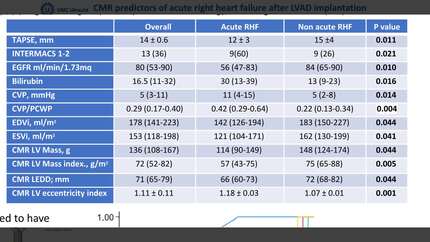
We enrolled 54 patients who underwent continuous-centrifugal flow LVAD implantation from 2013 to 2021 in whom a CMR within median time of 30 days pre-implantation was available. Four patients were excluded due to low quality images. Among the final cohort of 50 patients, 15 (28%) developed acute RHF. Patients who developed RHF showed worse INTERMACS class, worse renal and liver function, higher central venous pressure at RHC, worse TAPSE at echocardiography and overall smaller left ventricles at the CMR analysis when compared to those who had not acute RHF. No CMR derived right ventricle parameters nor moderate to severe tricuspid regurgitation at echocardiography were different among the two groups. We found that CMR-derived LV mass indexed < 65 g/m2, left ventricular end diastolic diameter (LVEDD) < 70 mm, and LV eccentricity index >1,12 were independent predictors of acute RHF. A CMR-derived score with these three parameters was built (1 point for each). This CMR score has shown to be an independent predictor of acute RHF at multivariate analysis with an odds ratio of 7,084 (CI 95%1.614-37.734) when corrected for other clinical and instrumental predictors of acute RHF.
Our study proposes a simple scoring system based on three CMR- derived parameters (LVEDD, LV mass indexed and LV eccentricity index) to screen for acute RHF prior LVAD implantation. This score shows promise to be an independent predictor of acute RHF, even when adjusted for clinical, echocardiographic, and haemodynamic parameters. Our model is built on CMR measurement of the LV, showing how patients with smaller ventricles and a left displacement of the interventricular septum (expressed with a higher LV eccentricity index) are at higher risk of developing acute RHF. ROC curves
Contributors


D Fedele
Author
G De Zan
Author
L N Broekhuizen
Author
A J Teske
Author

M I F Oerlemans
Author
G P J Van Hout
Author
A Dello Russo
Author
I Van Der Bilt
Author
P Van Der Harst
Author

You may be interested in