Disparities in SGLT2i utilization among heart failure patients with different ejection fraction in China: findings from chinese cardiovascular association database-heart failure center registry
European Heart Journal


Abstract
Sodium-glucose cotransporter-2 inhibitors (SGLT2i) are recommended for heart failure (HF) patients regardless of left ventricular ejection fraction (LVEF). Although Chinese HF guidelines still recommend traditional renin–angiotensin–aldosterone system inhibitors, beta blockers, mineralocorticoid receptor antagonists, the Chinese Cardiovascular Association (CCA) HF Center Registry has launched a project to promote the guideline-directed medical therapy (GDMT) for HF patients in China. However, data on the utilization of GDMT in Chinese HF patients is scarce, especially SGLT2i.
We aimed to investigate the usage status of SGLT2i in HF patients with different LVEFs and explore associated factors with SGLT2i adoption in hospitalized HF Chinese patients.
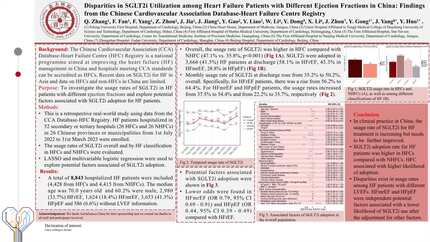
This is a retrospective real world study using data from the CCA Database-HF Center Registry. The study included HF patients hospitalized in 52 secondary or tertiary hospitals, including 26 accredited heart failure centers (HFC) and 26 non-accredited heart failure centers (NHFC). Centers that meet the 25 quality control standards established by CCA can be accredited as HFC. We evaluated the use rate of SGLT2i overall and by HF type, as well as the change of SGLT2i usage rate at discharge during the study period from 1st July 2022 to 31st March 2023. LASSO and multivariable logistic regression were also used to explore associated factors of SGLT2i adoption at discharge.
We included 8,843 hospitalized HF patients: 5,326 (60.2%) were male, 2,980 (33.7%) HFrEF, 1,624 (18.4%) HFmrEF, 3,653 (41.3%) HFpEF and 586 (6.6%) lacked EF data. Overall, SGLT2i were adopted in 3,666 (41.5%) HF patients at discharge (58.1% in HFrEF, 45.3% in HFmrEF, 28.8% in HFpEF). Overall, the usage rate of SGLT2i at discharge rose from 35.2% to 50.2%. Specifically, for HFrEF patients, there was a rise from 56.2% to 64.4%. For HFmrEF and HFpEF patients, the usage rate increased from 37.5% to 54.4% and from 22.2% to 35.7%, respectively (Figure 1). The usage rate of SGLT2i was higher in HFC compared with NHFC (47.1% vs. 35.8%, p<0.001). In multivariable logistic regression, older age, new-onset heart failure, hospital location, etc. were associated with a lower usage rate of SGLT2i at discharge. In contrast, HFC, dilated cardiomyopathy, obesity, etc. were associated with a higher utilization rate of SGLT2i (Figure 2). HF classification by LVEF was also an independent influencing factor even after adjusting other factors; when HFrEF was used as a reference, the use rate of SGLT2i was lower in HFmrEF (OR 0.79, 95% CI 0.69 - 0.91) and HFpEF (OR 0.44, 95% CI 0.39 - 0.49).
In clinical practice in China, the usage rate of SGLT2i for HF treatment is increasing but needs to be further improved. Disparities exist in usage rates among HF patients with different LVEFs. Addressing this disparity necessitates a targeted approach, emphasizing increased utilization in HF patients regardless of LVEF. SGLT2i usage rate in HF Factors affecting SGLT2i adoption in HF



You may be interested in