An elevated mPAP over CO slope by exercise echocardiography predicts outcome in unexplained dyspnea
European Heart Journal


Abstract
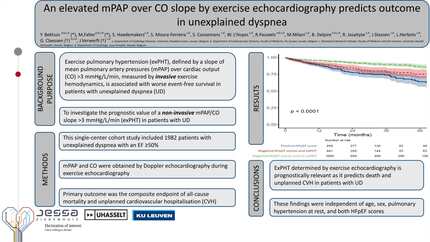
Exercise pulmonary hypertension, defined by a slope of mean pulmonary artery pressure (mPAP) over cardiac output (CO) >3 mmHg/L/min, measured by invasive exercise hemodynamics, is associated with worse event-free survival in patients with unexplained dyspnea. Whether non-invasive techniques yield similar results has yet to be tested.
To investigate the prognostic value of an mPAP/CO slope > 3 mmHg/L/min determined by exercise echocardiography in suspected heart failure with preserved ejection fraction (HFpEF).
This prospective cohort study included patients with unexplained dyspnea defined as dyspnea with an ejection fraction ≥50%. Patients with more than mild valvular heart disease, more than mild pulmonary disease, a history of heart failure, and myocardial or pericardial disease were excluded. A positive HFpEF score was defined as either an HFA-PEFF score of ≥5, including the diastolic stress test and exercise tricuspid regurgitation velocity, or a H2FPEF score of ≥6. The mPAP and CO were obtained by Doppler echocardiography. The primary outcome was the composite endpoint of unplanned cardiovascular hospitalisation (CVH) or all-cause mortality.
Among the 1922 patients studied (median age 66 [56 to 74] years, 48% women), 39% (n=721) had exercise pulmonary hypertension. After a median follow-up of 14 (10-34) months; 57(3%) patients died and 235 (12%) had at least 1 unplanned CVH. A mPAP/CO slope >3 mmHg/L/min predicted death or unplanned CVH with an odds ratio of 1.51(1.11-2.07) when adjusted for age, sex and pulmonary pressures at rest (Figure 1). The mPAP/CO slope had incremental prognostic value irrespective of whether patients had a positive HFpEF score or not (increase in χ² from 19 to 29; p =0.002) (Figure 2).
Exercise pulmonary hypertension determined by exercise echocardiography is prognostically relevant as it predicts death and unplanned CVH in patients with unexplained dyspnea. These findings were independent of age, sex, pulmonary hypertension at rest and both the HFpEF scores with the diastolic stress test included. KM exPHT KM exPHT and HFpEF score
Contributors


Y Bekhuis
Author
S Hoedemakers
Author
S Moura-Ferreira
Author
S Coosemans
Author
W L'hoyes
Author
R Pauwels
Author

B Delpire
Author
R Jasaityte
Author
J Stassen
Author

G Claessen
Author

You may be interested in