Right ventricular myocardial work predicts heart failure hospitalizations irrespective of ejection fraction
European Heart Journal


Abstract
Hospitalization for heart failure worsening (HFW) associates with increased subsequent rehospitalization rate and mortality irrespective of left ventricular ejection fraction (EF). However there’s little evidence regarding predictors of HFW to timely apply preventive measurements. Since right ventricular (RV) dysfunction often associates with more advanced stages of HF we assumed that RV myocardial work (MW) assessment might be used in prediction of HFW.
158 patients with HF (48% female) 58±7 years on guideline directed medical therapy in sinus rhythm and with at least one hospitalization in the last 6 months were enrolled in the study. Patients with HFrEF, HFmrEF and HFpEF were evenly represented. All patients were appropriately decongested prior to the study. The primary outcome was rehospitalization, HFW or cardiovascular death. RVMW was derived from RV global strain, including interventricular septum, and noninvasively estimated pulmonary arterial pressure (PAP). Systolic PAP (sPAP) was measured as the sum of maximum RV and right atrial (RA) pressure gradient (PGmax) from tricuspid regurgitation (TR) jet peak velocity and mean right atrial pressure (RAP) estimated from diameter and collapsing of inferior vena cava. Mean PAP (mPAP) was measured as the sum of PGmean RV-RA by tracing TR jet and RAP. Diastolic PAP was estimated as dPAP = 1.5 × [mPAP − (sPAP/3)]. Then RV global work index (RVGWI), constructive (RVGCW), and efficient work (RVGWE) were derived by the software dedicated for left ventricular MW. Left ventricular global longitudinal strain, left atrial (LA) reservoir strain (LAS), LA pump strain, LA volume index (LAVi), B lines, inferior vena cava, NT-pro-BNP, TAPSE/sPAP and RVMW were also measured. Patients followed up for 12 months.
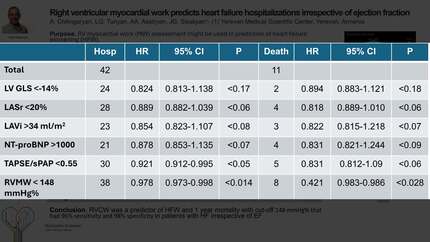
53 events were registered at 12 months of which 42 rehospitalizations due to HFW and 11 CV deaths. Among all parameters in the multivariate analysis lower RVGCW was associated with HFW (HR 0.978, 95% CI 0.973–0.998, p = 0.014). RVGCW was the most powerful predictor of CV events (AUC 0.91) with cut off value of 148 mmHg% that had 96% sensitivity and 88% specificity. Number of patients who died with RVGCW < 148 mmHg% was 8 of 11 (73%) total deaths (HR 0.421, 95% CI 0.083–0.986, p = 0.028).
RVGCW was a predictor of HFW and 1 year mortality in patients with HF irrespective of EF.
Contributors


You may be interested in