A streamlined protocol for exercise right heart catheterisation for the diagnosis of heart failure with preserved ejection fraction
European Heart Journal


Abstract
Heart failure with preserved ejection fraction (HFpEF) can be a challenging diagnosis. The gold standard diagnostic test is exercise right heart catheterisation (eRHC), with HFpEF confirmed if pulmonary capillary wedge pressure (PCWP) >15mmHg at rest or ≥25mmHg with exercise. However, many centres do not perform eRHC and the current, well-established, nine-minute eRHC protocol can be time consuming and costly.
We sought to determine whether an abbreviated 3-minute eRHC protocol is sufficient for accurate diagnosis of HFpEF, thus allowing simplification, reduced patient risk and costs, and broader uptake of eRHC across centres.
Patients undergoing eRHC between 09/09/2008 and 18/07/2023 at a tertiary hospital in Australia were retrospectively analysed. Haemodynamic measurements at three minutes of exercise were correlated with peak measurements.
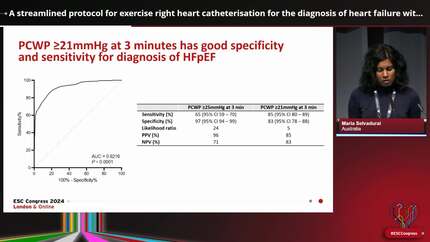
Overall cohort of n=532, with a mean age of 64 ± 12 years, and 60% female. Compared to PCWP ≥25mmHg at peak exercise, measurement of PCWP at 3 minutes yielded an area under the receiver-operating characteristic curve of 0.92±0.01, P<0.0001. PCWP ≥25mmHg at 3 minutes has a high specificity (97%) but moderate sensitivity (65%) for diagnosis of HFpEF; PCWP ≥21 mmHg at 3 minutes has good specificity (83%) and sensitivity (85%) for predicting peak PCWP ≥25mmHg. Using the 3-minute protocol with PCWP cut-off of 21mmHg, 86% of participants were correctly diagnosed (Figure 1). There were strong positive correlations in PCWP (R2=0.6922), cardiac output (R2=0.5543) and pulmonary vascular resistance (R2=0.6516) between 3 minutes and peak exercise (Figure 2).
Abbreviated 3-minute eRHC protocol has good diagnostic potential in HFpEF, with strong correlations in haemodynamics, when compared to peak exercise. This suggests that simplification of the current HFpEF protocol to 3 minutes exercise could be a valid strategy to enable improved uptake and maximise resource utilisation while maintaining diagnostic accuracy. Sankey plot of PCWP values Haemodynamics during eRHC


You may be interested in