Prognostic value of peak heart rate on cardiopulmonary exercise testing in patients with chronic heart failure
European Heart Journal


Abstract
Many factors are known to be related to impaired exercise capacity or worse clinical outcomes in patients with chronic heart failure (CHF). Peak heart rate achievement by cardiopulmonary exercise testing (CPET) can be easily obtained on CPET. However, less data is available regarding the impact of peak heart rate on exercise capacity or long-term clinical outcomes in patients with CHF.
We sought to investigate whether lower heart rate during peak exercise displayed poorer exercise capacity and worse clinical outcomes in patients with CHF.
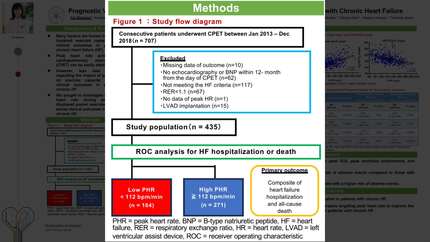
We examined consecutive 435 patients with CHF referred for CPET in our university hospital between 2013 and 2018. The primary outcome was a composite of all-cause death or hospitalization due to worsening heart failure. Patients were divided into two groups according to the optimal cut-off value of peak heart rate based on receiver operating characteristic curve analysis.
Patients with lower peak heart rate (≤112/min, n=164) were older and, higher brain natriuretic peptide level compared to those with higher peak heart rate (>112/min, n=271). Heart rate during peak exercise was significantly correlated with peak oxygen consumption (peak V̇O2) (Figure 1A), peak workload achievement (Figure 1B), and ventilatory efficiency (V̇E/V̇CO2 slope) (Figure 1C). There were 80 patients with events over a median follow-up period of 3.4 (Interquartile range 0.7–5.6) years. Patients with lower peak heart rate had about 3.0-fold higher risk of events compared to those with high peak heart rate (hazard ratio [HR] 3.17; 95% confidence interval [CI], 2.01–4.98) (Figure 2). In a multivariable Cox regression, 10 bpm-decreased in peak heart rate was associated with 12% increased adverse events (HR 0.88; 95%CI, 0.78–0.98).
Peak heart rate achievement on CPET was associated with reduced exercise capacity and worse clinical outcomes, suggesting that peak heart rate is useful for risk stratification in patients with CHF. Further study is required to identify therapies targeting peak heart rate to improve the exercise capacity or clinical outcomes in patients with CHF.
Contributors




You may be interested in