Machine-learning models to predict the risk of recurrent VT following catheter ablation in patients with structural heart disease
European Heart Journal


Abstract
Ventricular tachycardia (VT) is a life-threatening arrhythmia that can complicate structural heart disease. While catheter ablation is effective in treating this condition, the recurrence of VT after the procedure continues to be a concern. Consequently, there is a need for a reliable system to evaluate the likelihood of arrhythmia recurrence following an ablation.
To predict recurrence or repeat ablation after a VT catheter ablation procedure using machine learning (ML) models.
We conducted a single-center, retrospective study of all patients undergoing catheter ablation for scar-related VT between 2012 and 2022. Data collected included demographics, comorbidities, medications, relevant laboratory abnormalities, electrocardiograms, echocardiograms, detailed procedural characteristics, and outcomes. Python version 3.8.5 for exploratory data analysis (EDA) and visualization. Using six different ML models from the training set (90:10 split), we used 34 variables to predict the primary outcome, including VT recurrence or repeat catheter ablation. The accuracy of these models was compared using ROC curves based on their performance on the test set.
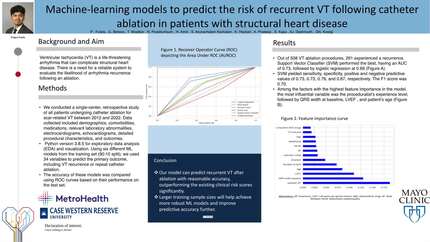
Out of 508 VT ablation procedures, 261 experienced a recurrence. Support Vector Classifier (SVM) performed the best, having an AUC of 0.73, followed by logistic regression at 0.69 (Figure A). SVM yielded sensitivity, specificity, positive and negative predictive values of 0.73, 0.73, 0.79, and 0.67, respectively. The F1 score was 0.70. Among the factors with the highest feature importance in the model, the most influential variable was the proceduralist’s experience level, followed by QRS width at baseline, LVEF, and patient’s age (Figure B).
Our model can predict recurrent VT after ablation with reasonable accuracy, outperforming the existing clinical risk scores significantly. Larger training sample sizes will help achieve more robust ML models and improve predictive accuracy further. Figure A: ROC curve depicting the AUROC B. Feature importance graph
Contributors



You may be interested in