Anticoagulation status and left atrial appendage occlusion indications in hospitalized cardiology patients with atrial fibrillation: a Hellenic Cardiorenal Morbidity Snapshot (HECMOS) sub-study
European Heart Journal


Abstract
Proper use of oral anticoagulants is crucial in the management of non-valvular atrial fibrillation (NVAF) patients. Left atrial appendage occlusion (LAAC) may be considered for stroke prevention in patients with NVAF and contraindications for long-term anticoagulant treatment.
We aimed to assess the anticoagulation status and LAAC indications in patients with NVAF from HECMOS (Hellenic Cardiorenal Morbidity Snapshot) survey.
HECMOS was a nationwide snapshot survey of cardiorenal morbidity in hospitalized cardiology patients. HECMOS used an electronic platform to collect demographic and clinically relevant information from all patients hospitalized on March 3, 2022, in 55 different cardiology departments. In this substudy, we included patients with known AF without mechanical prosthetic valves and moderate to severe mitral valve stenosis. Patients with poor adherence to anticoagulants, high bleeding risk, previous major bleeding, and previous stroke were considered candidates for LAAC.
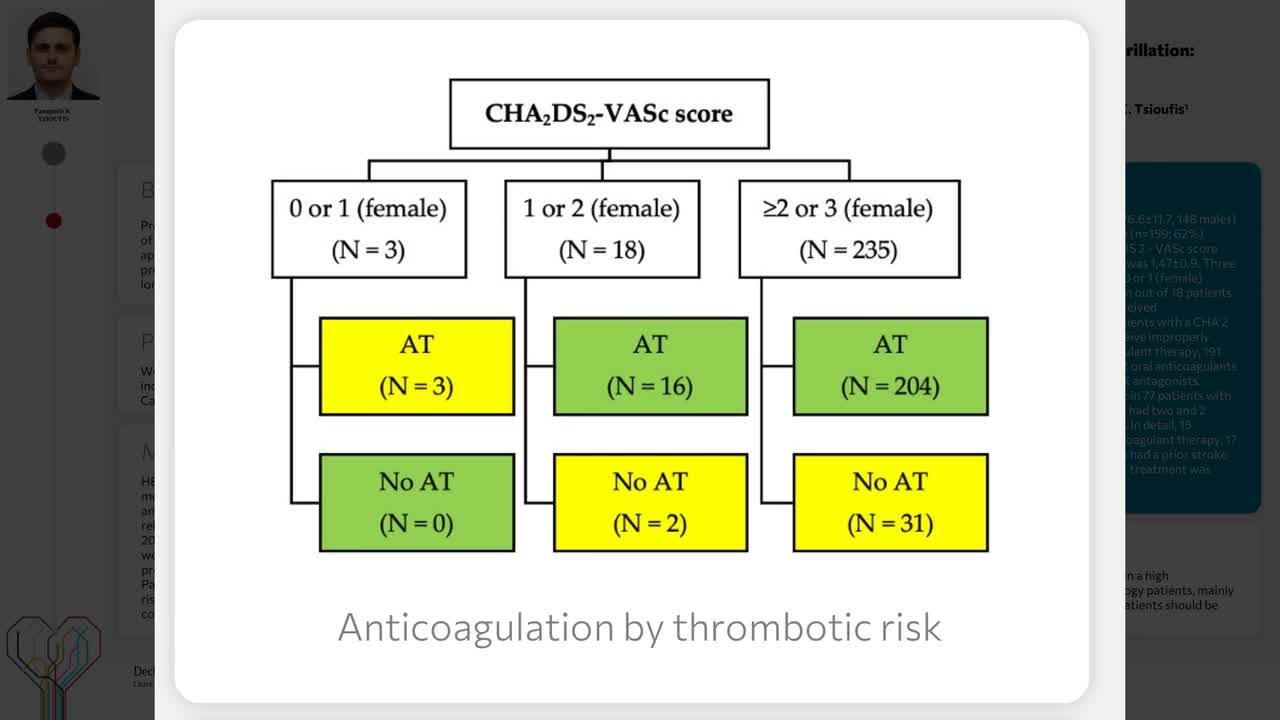
Two hundred fifty-six patients (mean age 76.6±11.7, 148 males) were included in our analysis. Most of them (n=159; 62%) suffered from persistent AF. Mean CHA 2 DS 2 - VASc score was 4.28±1.7, while mean HAS-BLED score was 1.47±0.9. Three out of 3 patients with a CHA 2 DS 2 -VASc 0 or 1 (female) received improperly anticoagulants. Sixteen out of 18 patients with a CHA 2 DS 2 -VASc 1 or 2 (female) received anticoagulants. Thirty-three out of 235 patients with a CHA 2 DS 2 -VASc > 1 or 2 (for female) did not receive improperly anticoagulants. Among 221 under anticoagulant therapy, 191 (86.4%) received non-vitamin K antagonist oral anticoagulants (NOACs) and 30 (13.6%) received vitamin K antagonists. Relative indications for LAAC were present in 77 patients with NVAF (53 had only one risk factor, while 22 had two and 2 patients had three concurrent risk factors). In detail, 15 reported poor or no adherence to the anticoagulant therapy, 17 patients had a history of major bleeding, 36 had a prior stroke and 35 had a HAS-BLED score ≥3. No LAAC treatment was recorded.
Αnticoagulation status was nearly optimal in a high thromboembolic risk population of cardiology patients, mainly treated with NOACs. Three out of ten AF patients should be screened for LAAC. Anticoagulation by thrombotic risk Potential LAAC candidates
Contributors



M Botis
Author

C K Antoniou
Author
A Kordalis
Author
N Argiriou
Author
A Laina
Author
K Dimitriadis
Author
G Koutsopoulos
Author
K Gatzoulis
Author
K Tsioufis
Author
You may be interested in