Predictors and outcomes of intracranial hemorrhage in 58,000 patients with atrial fibrillation on oral anticoagulation: insights from COMBINE-AF
European Heart Journal


Abstract
Among anticoagulated patients with atrial fibrillation (AF), intracranial hemorrhage (ICH) is the leading cause of bleeding-related death and disability. The COMBINE-AF database has patient-level data from four major randomized-controlled trials [ROCKET-AF (rivaroxaban), RE-LY (dabigatran), ENGAGE-TIMI 48 (edoxaban), ARISTOTLE (apixaban)] of direct oral anticoagulants (DOACs) versus warfarin in patients with AF.
We investigated the rates, predictors, and mortality of ICH in patients randomized to DOAC (rivaroxaban, dabigatran, edoxaban, apixaban) or warfarin. ICH was subclassified as subdural or non-subdural (intracerebral, intraventricular, subarachnoid, epidural). Multivariable Cox models were used to identify predictors of ICH. Frequencies and fatality rates of ICH were calculated and displayed as Kaplan-Meier curves.
In COMBINE-AF, there were 58,634 patients randomized to either DOAC (n=29,362) or warfarin (n=29,272). The mean age was 70.5 years, 37% were female, and 81% were White. The mean CHA2DS2-VASc score was 2.6, 43% of patients had a history of smoking, 31% had diabetes, and 29% had prior stroke/TIA.
After a mean of 32 months, ICH occurred in 593 patients (1.01%, 0.58 per 100-patient years, 95% CI [0.54, 0.63]). The most significant independent predictors of ICH in order of importance were: treatment with warfarin, older age, prior stroke/TIA, enrollment in Asia, antiplatelet use at randomization, and history/risk of falls (Figure 1).
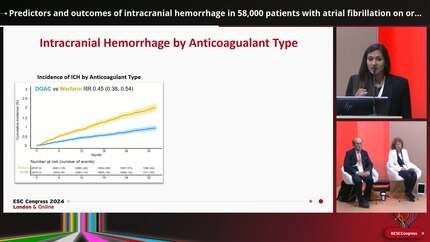
Mortality after ICH was 48.4% (287/593 participants), with a majority of deaths (82%) occurring within 30 days of ICH event. Non-subdural ICH was more common than subdural ICH (73% vs 25%) and had a higher risk of death (Figure 2). Participants randomized to DOAC had a lower risk of both subdural and non-subdural ICH than those treated with warfarin; however, mortality rates after ICH were similar regardless of anticoagulant type.
ICH is an uncommon but devastating complication of oral anticoagulation in patients with atrial fibrillation. The mortality rate following ICH is high, particularly following non-subdural ICH. To reduce the risk of ICH, clinicians should consider using DOACs over warfarin and carefully evaluate the need for antiplatelet therapy, particularly in patients with other significant predictors of ICH such as prior stroke, advanced age, residence in Asia, and history of falls. Predictors of Intracranial Hemorrhage 90-Day Mortality after ICH
Contributors



You may be interested in