Strategic timing- early and delayed catheter ablation in atrial fibrillation
European Heart Journal


Abstract
Atrial fibrillation (AF) is the most common sustained arrhythmia. AF catheter ablation (CA) is superior to antiarrhythmic drug (AAD) therapy in maintaining sinus rhythm. However, not much is known regarding the optimal timing of the ablation.
This review aims to examine the evidence supporting both early and delayed ablation approaches, as well as explore their respective disadvantages.
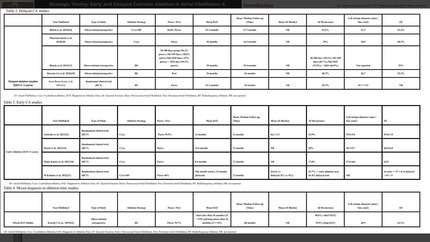
We performed an electronic search in databases such as PubMed, ScienceDirect, Springer, Wiley Online Library, focusing on studies published from 2013 until 2022 and including both observational studies and randomized controlled trials (RCTs). Left atrial diameter and ejection fraction (EF) were assessed. The limit between early and delayed ablation was set to be 3 years, considering delayed CA studies with a diagnosis-to-ablation-time (DAT) of 3 years or more, and early CA studies with a DAT of less than 3 years. Included studies were selected according to our eligibility criteria: observational studies or RCTs that included patients with symptomatic paroxysmal or persistent AF that underwent ablation using either radiofrequency or cryoballoon approach or both approaches, studies that reported DAT, studies that included a follow-up period, studies that evaluated AF recurrence or AF burden. Studies that included a surgical ablation, a hybrid ablation approach, or ablation for arrhythmias other than AF were excluded.
Ten studies were selected out of 1387 identified records. After a follow-up period of 1 year, the early ablation subgroup had a lower mean AF recurrence rate (31.1%) compared to that of the delayed ablation subgroup (37.7%) ( p<0.0004). The median AF recurrence rate in radiofrequency ablation group was (47.8%) in comparison to the AF recurrence rate in cryoablation group which was (27.4%) (p<0.0001). In studies that included paroxysmal AF patients exclusively, the AF recurrence rate was directly proportional to the DAT(R=0.95).
Our results demonstrate that DAT correlates with recurrence rate at 1 year following AF CA, the shorter the DAT the better the outcome especially in paroxysmal AF population. Prisma study selection flow diagram Correlation between DAT-AF recurrence
Contributors



R Vatasescu
Author
Clinical Electrophysiology and Pacing Laboratory Emergency Clinical Hospital Floreasca Bucharest , Romania

You may be interested in