Long-term patient clinical benefits and healthcare utilization after pulsed field ablation in paroxysmal atrial fibrillation: sub-analyses from the multicenter inspIRE trial
European Heart Journal


Abstract
The treatment of atrial fibrillation (AF) with pulsed field ablation (PFA) aims to prevent AF recurrence while reducing complications from the ablation modality. Similar to thermal ablation, PFA has proven to be safe and effective for treatment of paroxysmal AF (PAF); however, there is scarce evidence on patient-related clinical benefits, including healthcare utilization, using this new energy modality.
The objective of this study is to assess long-term clinical improvements in patient care, symptoms, and quality-of-life (QOL) after PFA ablation in PAF.
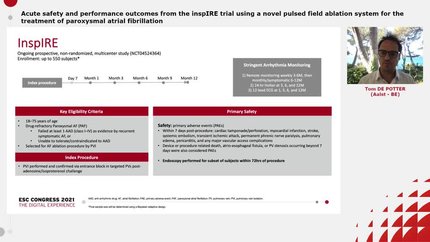
InspIRE was a multicentre study evaluating the safety and efficacy of variable loop PFA catheters integrated with a 3D mapping system for treatment of symptomatic PAF. Patients were followed for up to 12 months for the following QOL and healthcare utilization endpoints: Atrial Fibrillation Effect on Quality-of-Life (AFEQT) score, Class I/III AAD utilization, repeat ablation, incidence of direct current cardioversion (DCCV), and cardiovascular (CV) hospitalization. Post-hoc Kaplan-Meier estimates for clinical benefit success at 12 months were provided. Success was defined as composite freedom from occurrence of the following events post-blanking: repeat ablation, CV hospitalization, AAD utilization, and DCCV post-blanking. Predictors of clinical benefit success were explored via multivariate logistic regression analysis.
A total of 186 enrolled patients (59±10 years; 70.0% male; CHA2DS2-VASC score 1.3±1.2) underwent PVI. Compared to baseline: 1) improvements in the AFEQT composite score were seen at 12 months (P<0.001); 2) Class I/III AAD use was reduced from 81.7% to 20.1% at 6-12 months (P<0.05); and 3) the proportion of subjects with DCCV decreased from 13.7% up to 12 months before the index procedure to 3.3% up to 12 months after the index procedure (P<0.001, Figure 1). Minimal clinically important difference in QoL (≥5 points improvement in AFEQT) was achieved in 85.2% of patients. Patients free from 12-month AF/AT/AFL recurrence (asymptomatic and symptomatic) had significantly greater improvements in AFEQT scores from baseline to 12 months versus those with recurrence (P=0.01).
The clinical benefit success rate at 12 months was 87.5% (Figure 2). Patients who failed the clinical benefit endpoint were counted, including those with repeat ablation (7.5%), those on new or higher dose of AAD (6.5%), those hospitalized for CV (4.8%), and those who had DCCV post-blanking (1.6%). Multivariate logistic regression analysis showed that left ventricle ejection fraction <60% (OR: 0.22; 95% CI: 0.08-0.62; P<0.05) and incidence of diabetes (OR: 7.25; 95% CI: 2.00, 26.3; p<0.05) were associated with a higher risk of clinical benefit failure.
PFA ablation of PAF patients led to a clinical benefit success rate of 87.5%, with clinically meaningful improvement in QOL, as well as a reductions in AAD use, cardioversion, and hospitalization. Improvements in QoL and Health Kaplan-Meier Analysis of Time
Contributors





You may be interested in