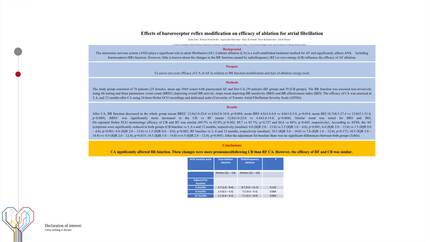
Effects of baroreceptor reflex modification on efficacy of ablation for atrial fibrillation
European Heart Journal


Abstract
The autonomic nervous system (ANS) plays a significant role in atrial fibrillation (AF). Catheter ablation (CA) is a well-established treatment method for AF and significantly affects ANS, including baroreceptors (BR) function. However, little is known about the changes in the BR function caused by radiofrequency (RF) or cryo-energy (CB) influence the efficacy of AF ablation.
To assess one-year efficacy of CA of AF in relation to BR function modification and type of ablation energy used.
The study group consisted of 78 patients (25 females, mean age 58±9 years) with paroxysmal AF and first CA (39 patients (RF group) and 39 (CB group)). The BR function was assessed non-invasively using tilt testing and three parameters: event count (BREC) depicting overall BR activity, slope mean depicting BR sensitivity (BRS) and BR effectiveness index (BEI). The efficacy of CA was assessed at 3, 6, and 12 months after CA using 24-hour Holter ECG recordings and dedicated scale (University of Toronto Atrial Fibrillation Severity Scale (AFSS)).
After CA, BR function decreased in the whole group (mean BREC 12.0±3.0-22.0 vs 6.0±3.0-18.0, p=0.004; mean BRS 4.8±3.6-6.8 vs 4.0±3.0-5.8, p=0.014; mean BEI 18.7±8.3-27.4 vs 12.0±5.1-21.0, p=0.009). BREC was significantly more decreased in the CB vs RF (mean 12.0±3.0-22.0 vs 6.0±3.0-18.0, p=0.004). Similar trend was noted for BRS and BEI.
On repeated Holter ECG monitorings efficacy of CB and RF was similar (89.7% vs 82.9% p=0.502, 89.7 vs 85.7%; p=0.727 and 84.6 vs 80%; p=0.602, respectively). According to AFSS, the AF symptoms were significantly reduced in both groups (CB baseline vs 3, 6 a and 12 months, respectively (median): 6.0 (IQR 2.0 – 13.0) vs 2.5 (IQR 1.0 – 4.0), p<0.001; 6.0 (IQR 2.0 – 13.0) vs 1.5 (IQR 0.0 – 4.0), p<0.001; 6.0 (IQR 2.0 – 13.0) vs 1.5 (IQR 0.0 – 4.0), p=0.002; RF baseline vs 3, 6 and 12 months, respectively (median): 10.5 (IQR 5.0 – 14.0) vs 7.0 (IQR 1.0 – 12.0), p=0.173; 10.5 (IQR 5.0 – 14.0) vs: 6.0 (IQR 2.0 – 12.0), p=0.015; 10.5 (IQR 5.0 – 14.0) vs 6.5 (IQR 2.0 – 12.0), p=0.005). After the adjustment for baseline there was no significant differencies between both groups (Table).
CA significantly affected BR function. These changes were more pronounced following CB than RF CA. However, the efficacy of RF and CB was similar.
Contributors


You may be interested in