Do CYP2D6 polymorphisms affect the efficacy and toxicity of flecainide? A cohort study
European Heart Journal


Abstract
The CYP2D6 enzyme, coded by the CYP2D6 gene, is the primary metabolic pathway for flecainide.(1,2) Over the years, studies on how different variants of this gene affect flecainide metabolism and efficacy have yielded contradictory results.(3–7) This is likely due to the fact that CYP2D6 pharmacogenetic classifications were not standardized until 2017.(8,9)
To date, there has been no published study using a standardized classification to assess the efficacy and toxicity of flecainide across different CYP2D6 phenotypes; therefore, we decided to study this.
We conducted a cohort study with data collected through indirect methods, blinding all parties involved except the statistician. We identified patients with flecainide prescriptions (100 mg/12 h) and follow-up in our health area (n=450,136 people) between 2017 and 2021. A primary combined endpoint composed of initial inefficacy and early toxicity was pre-set, and a secondary combined endpoint of toxicity or inefficacy during follow-up.
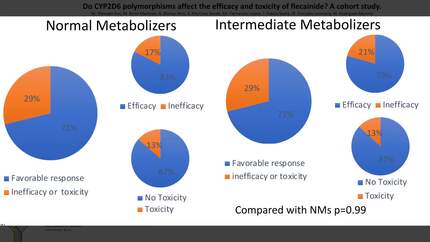
104 patients met the criteria and agreed to participate: 38 (36.5%) intermediate metabolizers, 52 (50%) normal metabolizers, 2 (1.9%) could not be classified with certainty (compatible with intermediate or normal metabolizers), 7 (6.7%) poor metabolizers, 4 (3.8%) ultra-rapid metabolizers, and 1 (1%) possible hybrid.
Intermediate and normal metabolizers showed an almost superimposable incidence of the primary endpoint (28,9% vs 28,8%, p=0.99), early inefficacy (21,6% vs 17,4%, p=0.97) and early toxicity (13,2% vs 13,3%, p=0.72). No significant differences were observed in multivariate analysis (p=0.76, picture 1) or in a combined endpoint of toxicity or inefficacy during follow-up (p=0.58, Kaplan-Meier in picture 2). Differences were seen in the primary endpoint when comparing poor metabolizers to the rest of the sample, although they did not reach statistical significance (p=0.07), likely due to the small number of patients in this group (n=7, absolute risk reduction -32%; 95% confidence interval: -41% to -23%).
Using the standardized classification for CYP2D6 pharmacogenetics, no statistically significant differences were detected between the two largest groups, intermediate and normal metabolizers. It is possible that better results are achieved in poor metabolizers. Based on these results, it is worth questioning whether, in an attempt to minimize the risk of flecainide toxicity, doses that are subtherapeutic in all groups except slow metabolizers have been used unknowingly.
Contributors

M B M Brion Martinez
Author
A B V Blanco Vera
Author
J L M S Martinez Sande
Author
X A F L Fernandez Lopez
Author
J G S Garcia Seara
Author
J R G J Gonzalez Juanatey
Author
M R M Rodriguez Manero
Author
You may be interested in