Cluster-specific risk factors for suboptimal thromboprophylaxis in contemporary European cohort of patients with atrial fibrillation: the EHRA-PATHS Project
European Heart Journal


Abstract
Oral anticoagulation (OAC) is essential to optimal thromboprophylaxis in patients with atrial fibrillation (AF). Owing to bleeding risk concerns, OAC use may be challenging in clinically complex high-risk AF patients. Comorbidities might lead to suboptimal OAC use. We assessed cluster-specific risk factors for non-prescribing OAC in pre-defined AF clusters in contemporary European EHRA-PATHS AF cohort.
The EHRA-PATHS AF cohort was constructed using data from the three prospective EurObservational Research Programme (EORP) AF registries - General Pilot, General Long-term, and AF III registry. A two-step cluster analysis was performed. A hierarchical cluster analysis with 18 variables was used to identify the optimal number of clusters, followed by a K-means cluster analysis to determine variable cluster association. Cluster-specific risk factors for non-prescribing OAC were identified using univariate and multivariate logistic regression analyses.
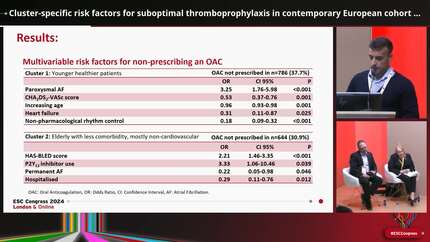
Of 18.799 patients, 2086 (11.1%) were not prescribed with OAC. Among the three clusters (see Table), OAC non-prescribing was significantly more prevalent in Cluster 1 (younger healthier AF patients) compared with Cluster 2 (Elderly with less comorbidity, mostly non-cardiovascular) or Cluster 3 (Elderly with more comorbidity, mostly cardiovascular), both P<0.001, with no significant difference between Clusters 2 and 3 (P=0.161). Cluster-specific multivariable risk factors for non-prescribing OAC are shown in Table. In all three clusters AF clinical type was significantly associated with OAC non-use. In Cluster 1, OAC non-use was less likely in the presence of CHA2DS2-VASc stroke risk factors, while bleeding risk factors were predominant multivariable predictors of OAC non-use among elderly (Clusters 2 and 3).
Our findings in a large contemporary European cohort suggest that different considerations prevail in treatment decision on OAC use in AF patients in clinical practice, depending on patient’s age and AF clinical type, as well as the presence and type of underlying comorbidities. Our findings could help in formulating targeted interventions to optimize stroke prevention in different subgroups of AF patients.
Contributors




You may be interested in